
Florida rewrote the inland edge of its Wind-Borne Debris Region, un-rewrote it, studied it, and then decided to leave it alone. All of that happened in under three years, most of it in documents almost nobody reads. If you own a home near a big Florida lake, the paper trail matters, so here is the whole story, with the primary sources.
We build and maintain the wind zone lookup tool from the same official GIS lines the building departments use, and we mapped every stage of this saga for every risk category. Short version: nothing changes on December 31, 2026 and the wind at your address never changed at all. The interesting part is what almost happened.
What the Wind-Borne Debris Region is
The Wind-Borne Debris Region (WBDR) is the part of Florida where the building code requires every glazed opening (windows, doors, and skylights) to be impact-rated or protected by approved shutters. It has two triggers:
- Anywhere the ultimate design wind speed reaches 140 mph or higher.
- A band at 130 mph or higher near the water, and the definition of "near the water" is what this whole story is about.
For decades trigger 2 read "within 1 mile of the coastal mean high-water line." Simple, coastal, familiar.
December 31, 2023: the line quietly moves inland
The 8th Edition (2023) Florida Building Code aligned its wind provisions with the national ASCE 7-22 standard, and ASCE 7-22 had dropped the word "coastal." Its version of trigger 2: within 1 mile of any mean high-water line where an Exposure D condition exists upwind, meaning at least 5,000 feet of open water in the upwind direction. Wind blowing across three miles of lake behaves like wind blowing across three miles of ocean, so the standards committee stopped distinguishing them.
The official Analysis of Changes for the 8th Edition spelled out the effect: inland areas near large bodies of water in the 130-140 mph band "will now be in a Windborne Debris Region." On paper, from December 31, 2023, lakeshore homes near Clermont, Winter Haven, and hundreds of other inland waterfronts in Central Florida and the Panhandle were in the WBDR: impact-rated openings or shutters required, like the coast.
2024: the rarely-used undo button
The construction industry noticed. In April 2024 the Building Commission's Structural Technical Advisory Committee voted 10-1 to put "coastal" back and to commission a science-based study before touching the definition again. The fix went through as a 2024 Annual Technical Amendment (Supplement 2 to the 8th Edition, August 2024), a mid-cycle correction mechanism Florida almost never uses. Enforcement of the inland reading was, in the words of one industry group, averted.
So the inland WBDR was law for roughly seven months, and most homeowners inside it never knew.
2024-2025: the state studies the risk it just un-regulated
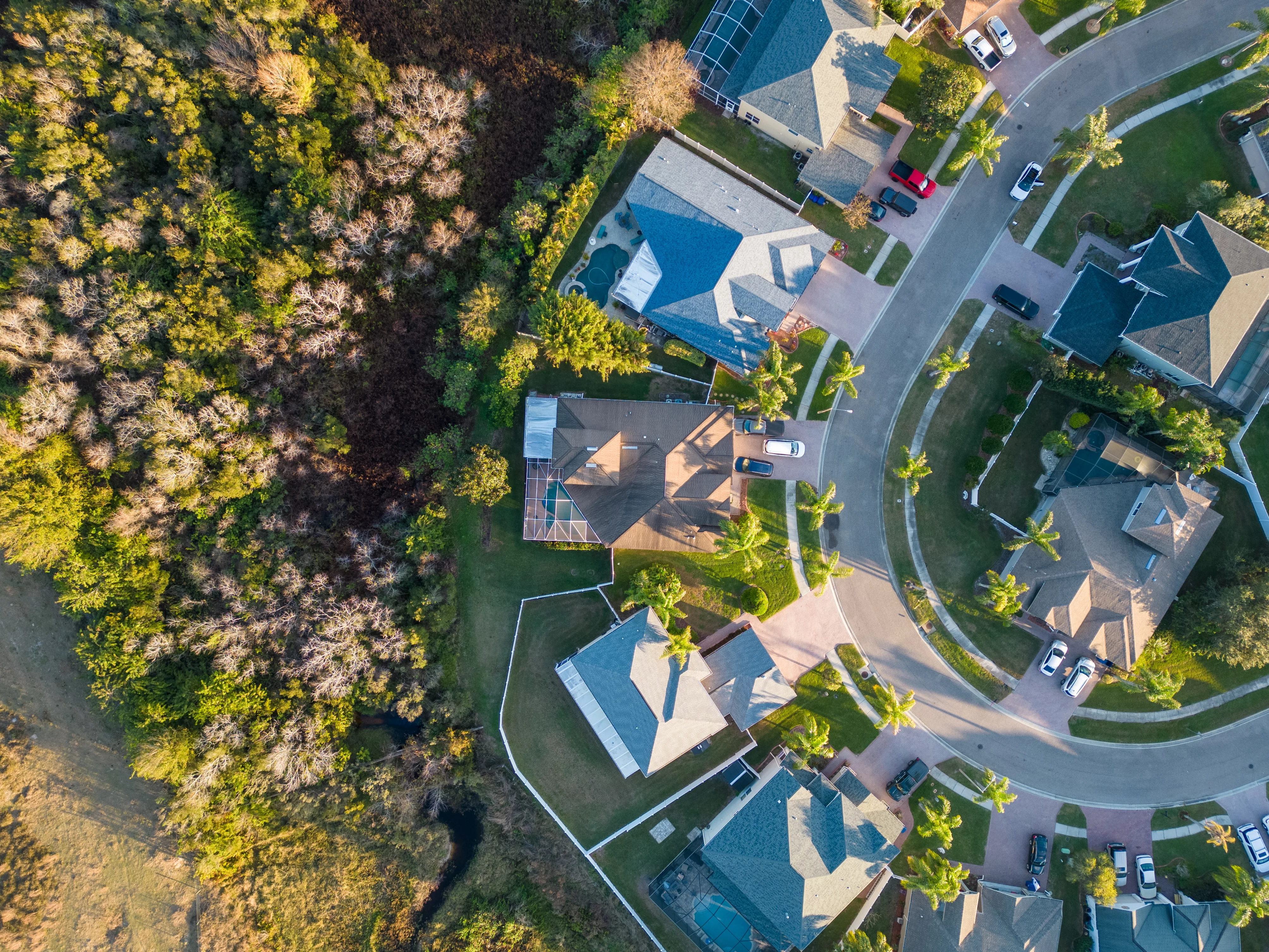
The commissioned study, by the University of Florida and Applied Research Associates for the Building Commission, is worth reading if you live near a lake. It reviewed post-hurricane damage assessments and found wind-borne debris damage well inland: more than three miles from the coast after Hurricane Charley (2004), and more than three miles from an inland bay after Hurricane Michael (2018). It also mapped, county by county, the lake and bay shorelines the ASCE 7-22 rule would designate, roughly 2,760 square miles of them on the Risk Category II map by our measurement of the same official lines.
The study's careful conclusion: the inland debris risk is real, but the research to draw an exact risk-consistent line does not exist yet.
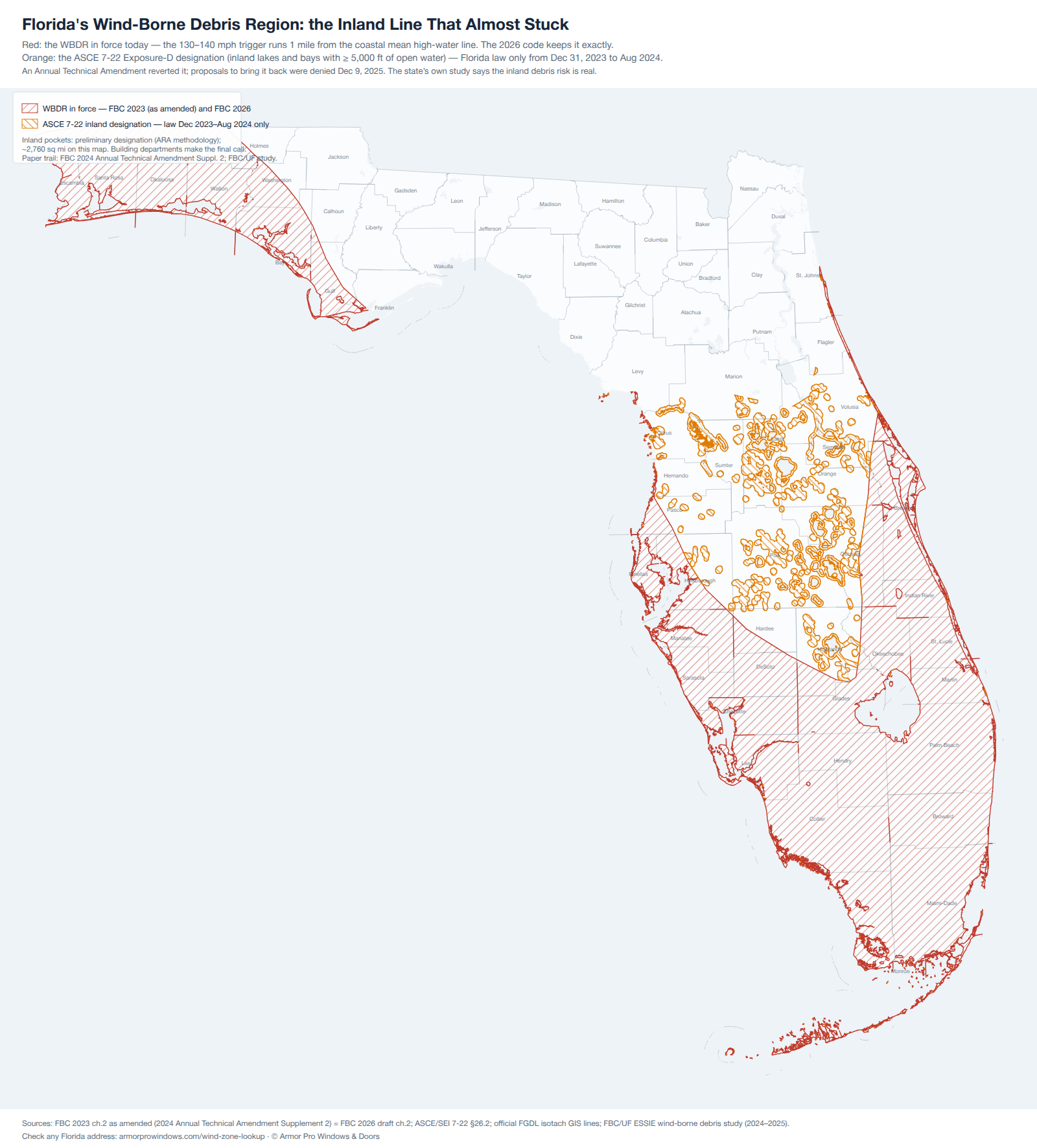
Red: the WBDR in force, unchanged by the 2026 code. Orange: the inland designation that was law from December 31, 2023 to August 2024 — roughly 2,760 square miles of lake and bay shoreline on the Risk Category II map. Drawn from the official FGDL GIS lines; the current wind zone maps for every risk category live on our lookup page.
December 2025: the line stays coastal
Two code modification proposals would have struck "coastal" again for the 9th Edition (2026). On December 9, 2025, the Building Commission denied them, 12-2 and 13-1, at the proponent's own request so the work could continue, as we covered in our report on the inland expansion proposals. Related legislation (HB 911 / SB 1218) died in committee in March 2026.
The result: the 9th Edition, effective December 31, 2026, keeps the coastal definition, the same wind speed maps, and the same HVHZ. For the WBDR, the 2026 code changes nothing.
What this means if you live near a big lake
Your code obligations are the coastal rule's. Unless you are within 1 mile of the coast in the 130-140 mph band, or anywhere at 140 mph and above, replacement windows do not have to be impact-rated. Check your address; the tool also tells you whether your home sat inside the short-lived 2024 inland designation.
The risk the state studied did not go away when the definition reverted. The study's damage evidence is exactly the kind lakeshore homeowners should weigh: debris travels, and a design-level event does not check the code line first. The commission left the door open to revisit the definition in a future cycle with better research.
If you are choosing impact windows anyway, the reasons most of our lakeside customers cite are the everyday ones: storm protection with no ladder work, insurance credits, noise, security, and UV protection. Those do not depend on which side of a definitional dispute your shoreline sits.
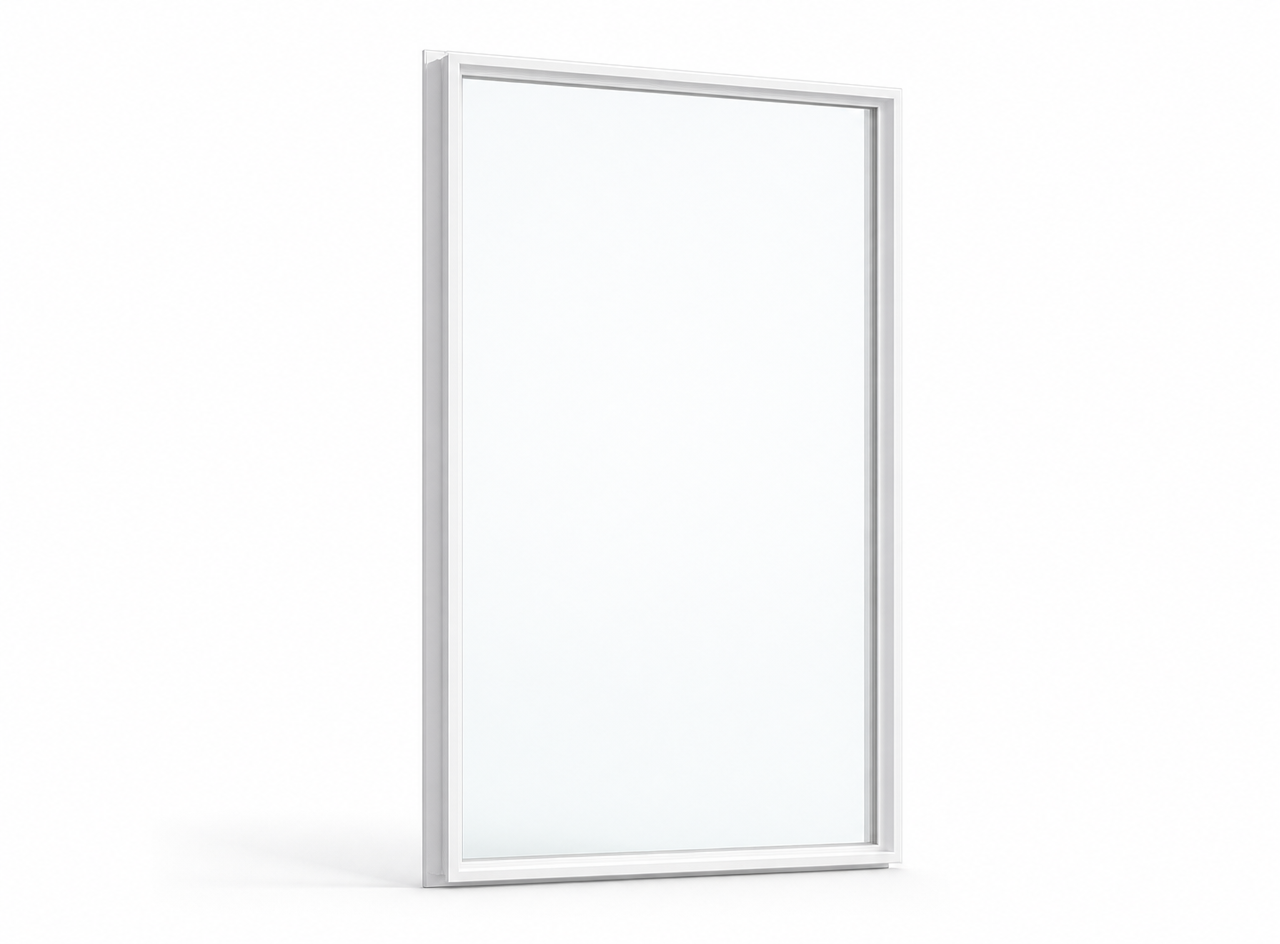
 PGT · WinGuard Aluminum Series
PGT WinGuard Aluminum Picture PW7720A
Aluminum impact fixed picture window on the WinGuard 7720 picture platform for unobstructed view installations. Diamond Glass, LMI for HVHZ.

 ECO · Eco-Guard Architectural Fixed Window Series
Eco-Guard Architectural Fixed Window Series 350
3-3/8 in. aluminum impact fixed window with optional SentryGlas/SaflexSGP, +75/-105 psf, LMI+SMI, up to 54 x 120 in.
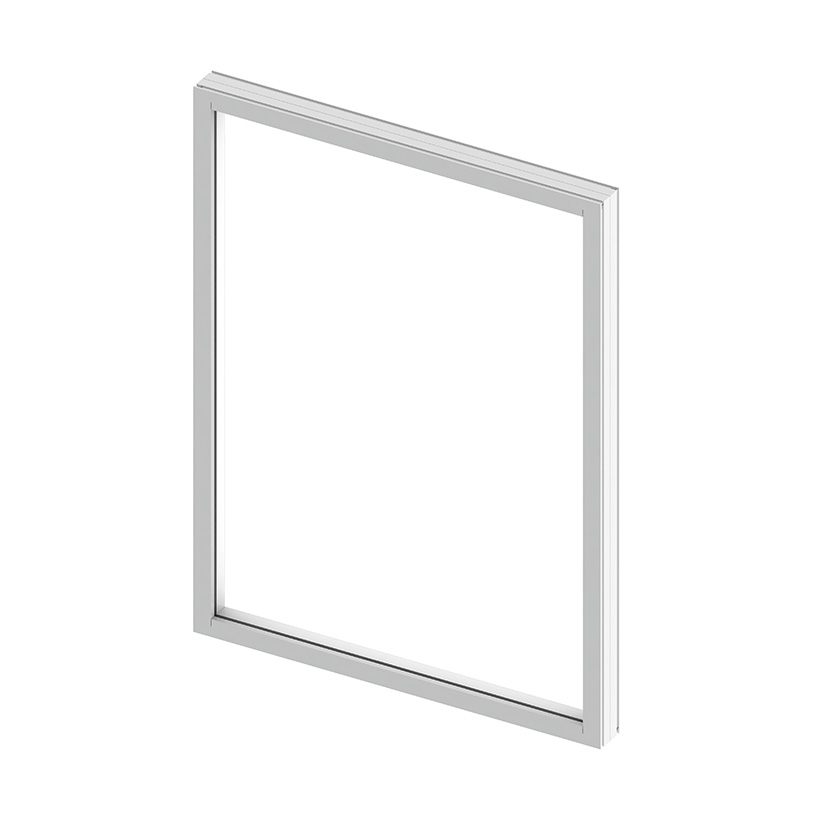
 ES Windows · Elite Series
ES Windows Elite ES-EL150 Fixed Window
Aluminum impact fixed window on a 2-15/16 inch frame, matching the rest of the Elite residential line for clean sightline continuity.
Sources: FBC 2023 Analysis of Changes; FBC 2024 Annual Technical Amendment Supplement 2 (Building Commission, April-August 2024); FBC/UF ESSIE "Investigation of the Wind-borne Debris Regions in ASCE 7-22" (interim Dec 2024, final 2025); Florida Building Commission actions of December 9, 2025; 9th Edition (2026) draft code and Analyses of Changes. The 9th Edition remains a draft until publication; the Commission's published text controls.