
Florida Building Code Tool
Florida Wind Zone & Building Code Lookup
Enter your Florida address and see your design wind speed, regulatory zone, required certifications, and estimated insurance savings in one click.
Florida addresses only. Pick a suggestion, or press Enter to look up a street address.
Risk Category II covers most homes (700-year mean recurrence interval). III applies to schools and hospitals; IV to essential facilities like fire stations.
Enter your address to see your design wind speed, building code zone, required certifications, and estimated insurance savings.
Florida Wind Zones at a Glance
The Florida Building Code 8th Edition (2023) divides the state into wind zones based on ASCE 7-22 design wind speeds (3-second gust, Risk Category II). The regulatory tier — High Velocity Hurricane Zone, Wind-Borne Debris Region, or Standard — determines what type of impact window certification a property needs.
| Zone | Counties | Wind Speed | Window Requirement |
|---|---|---|---|
| High Velocity Hurricane Zone (HVHZ) | Miami-Dade, Broward | 170–175 mph | Miami-Dade NOA required (TAS 201/202/203) |
| Wind-Borne Debris Region | Palm Beach, Monroe, Pinellas, Lee, Collier, Brevard, Hillsborough, Sarasota, Manatee, Pasco, Charlotte, Indian River, Martin, St. Lucie and other coastal counties | 130–170 mph | Florida Product Approval or Miami-Dade NOA |
| Standard | Interior North Florida counties | 105–130 mph | No impact certification required (recommended) |
What This Means for Your Windows
If your home is in the HVHZ, every window and door must carry a current Miami-Dade Notice of Acceptance (NOA). Products are tested by firing a 9 lb 2×4 at 34 mph, then cycling 9,000 pressure changes. The interlayer tear tolerance is just 5 inches × 1/16 inch — the tightest standard in the nation.
In the Wind-Borne Debris Region, impact-rated products or approved coverings are required on all new construction and major remodels. Florida Product Approval is the minimum; Miami-Dade NOA products are accepted everywhere in the state.
Even in Standard zones, impact windows are recommended for insurance savings, energy efficiency, noise reduction, and security.
Sources: Wind speed data from ASCE 7-22 via University of Florida GeoPlan Center (FGDL). Hurricane risk data from FEMA National Risk Index (March 2023). Historical storm tracks and local wind-frequency estimates from the NOAA IBTrACS / HURDAT2 best-track archive (1900–2025). Regulatory requirements from Florida Building Code 8th Edition (2023) §1609.2.
Need to know exactly what your home requires? An Armor Pro specialist can verify your zone, take precise measurements, and quote products that meet or exceed code.
Get a Free In-Home AssessmentDisclaimer: This tool provides approximate design wind speeds interpolated from ASCE 7-22 contour data published by the University of Florida GeoPlan Center. Values are for general informational purposes only. Actual design pressures must be calculated by a licensed Professional Engineer using site-specific parameters (building height, exposure category, topography, opening location). Regulatory zones are based on Florida Building Code 8th Edition (2023); verify with your local building department before purchasing products. Insurance ranges are estimates; actual savings depend on your insurer, coverage, and the results of a certified wind mitigation inspection (Form OIR-B1-1802).
How the Code Tiers Work
Florida is the only state in the nation that splits hurricane-prone areas into three regulatory tiers. Each tier prescribes the testing standard, certification, and exposure category that opening protections must meet.
- HVHZ — Miami-Dade County and Broward County. Products must carry a current Miami-Dade Notice of Acceptance, the strictest impact and pressure cycle test in the United States.
- Wind-Borne Debris Region — Areas where the design wind speed is at least 140 mph, or 130 mph within one mile of the coastal mean high-water line. Florida Product Approval is the minimum; Miami-Dade NOA products are accepted everywhere.
- Standard — Inland counties under 130 mph. No impact certification is required, though impact-rated products still qualify for insurance discounts and OIR-B1-1802 wind mitigation credits.
Not sure whether your current windows already meet the standard? There are five quick ways to check if your windows are impact-resistant. If they aren't, our cost calculator prices an upgrade for your exact address.
What the Numbers Represent
Design wind speeds are expressed as 3-second gust values from ASCE 7-22, the wind load standard adopted by the Florida Building Code 8th Edition. Risk Category II covers single- and multi-family homes (a 700-year mean recurrence interval); Risk Categories III and IV apply to schools, hospitals, and emergency facilities and use higher recurrence intervals.
The minimum DP rating for a window depends on building height, wall zone, and exposure category. The values shown are typical minimums for a single-story residential building in Exposure C. A licensed Professional Engineer must size design pressures for any permit.
Product approvals and DP ratings vary by manufacturer; our comparison of Florida's six major impact window manufacturers lists maximum ratings and HVHZ coverage for each.
Wind-Borne Debris Region (WBDR) in Florida
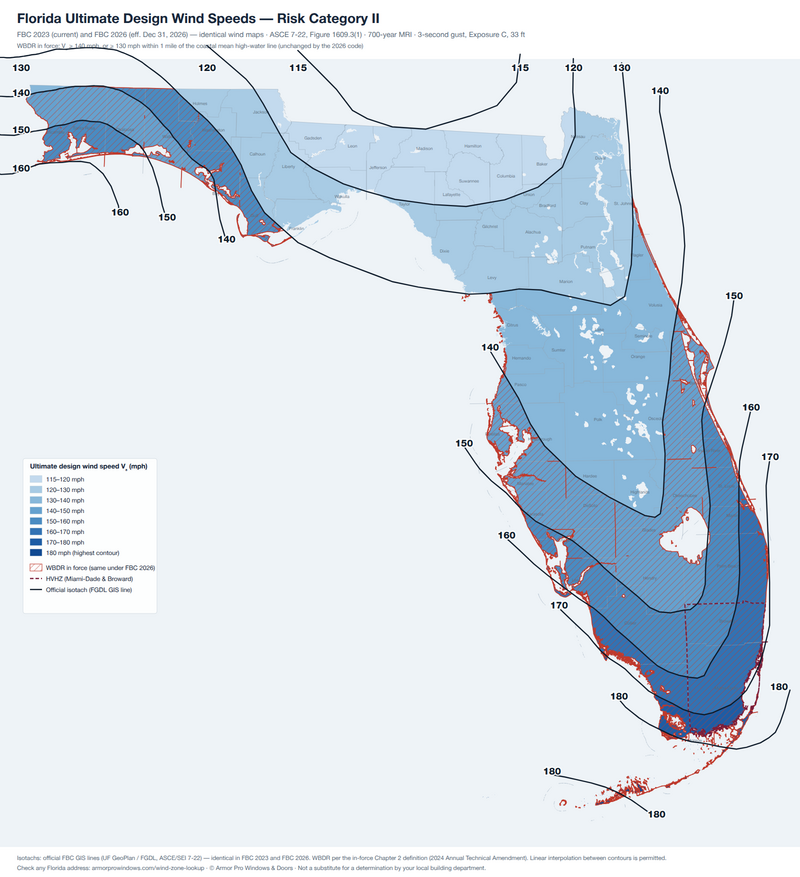
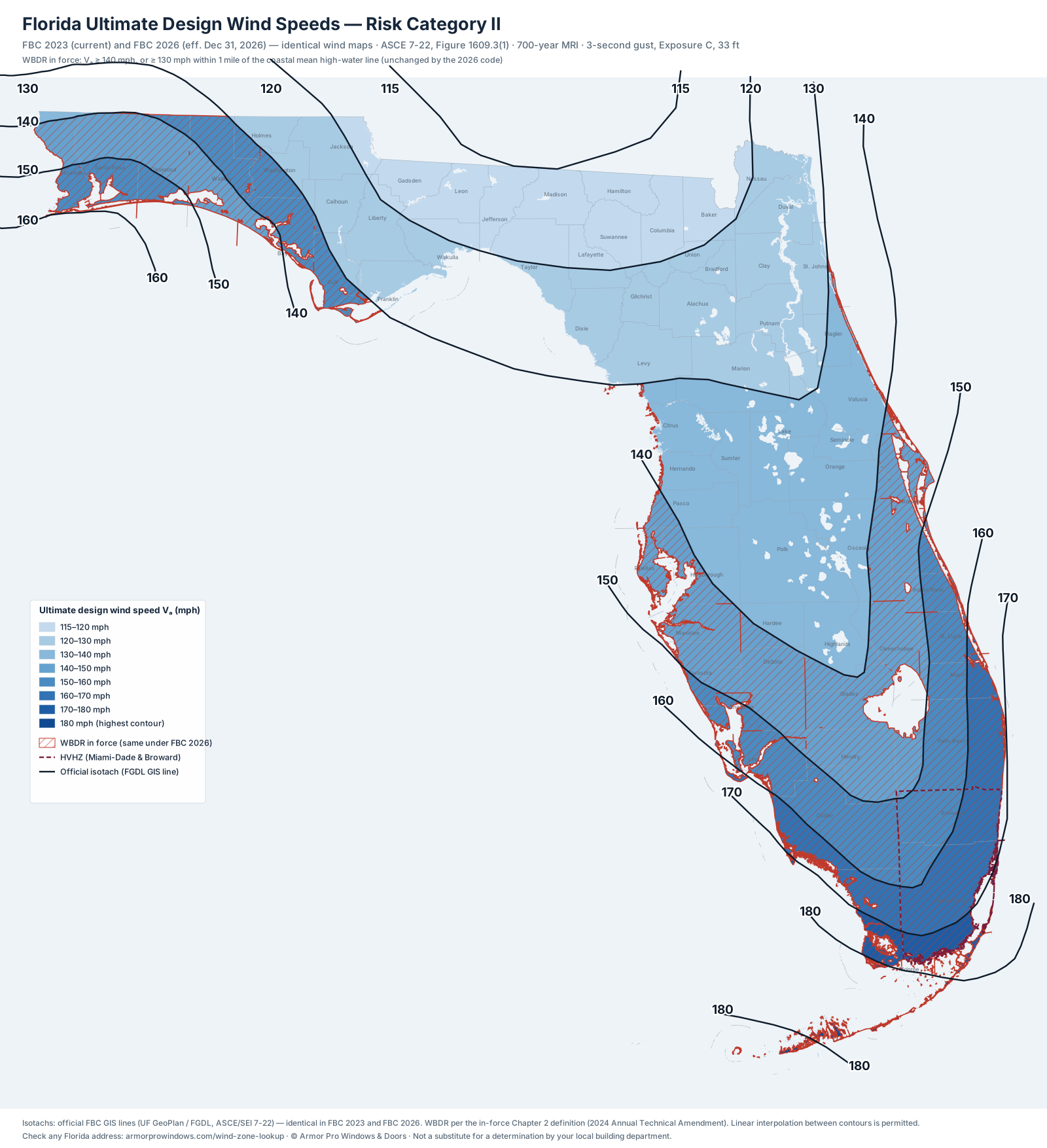
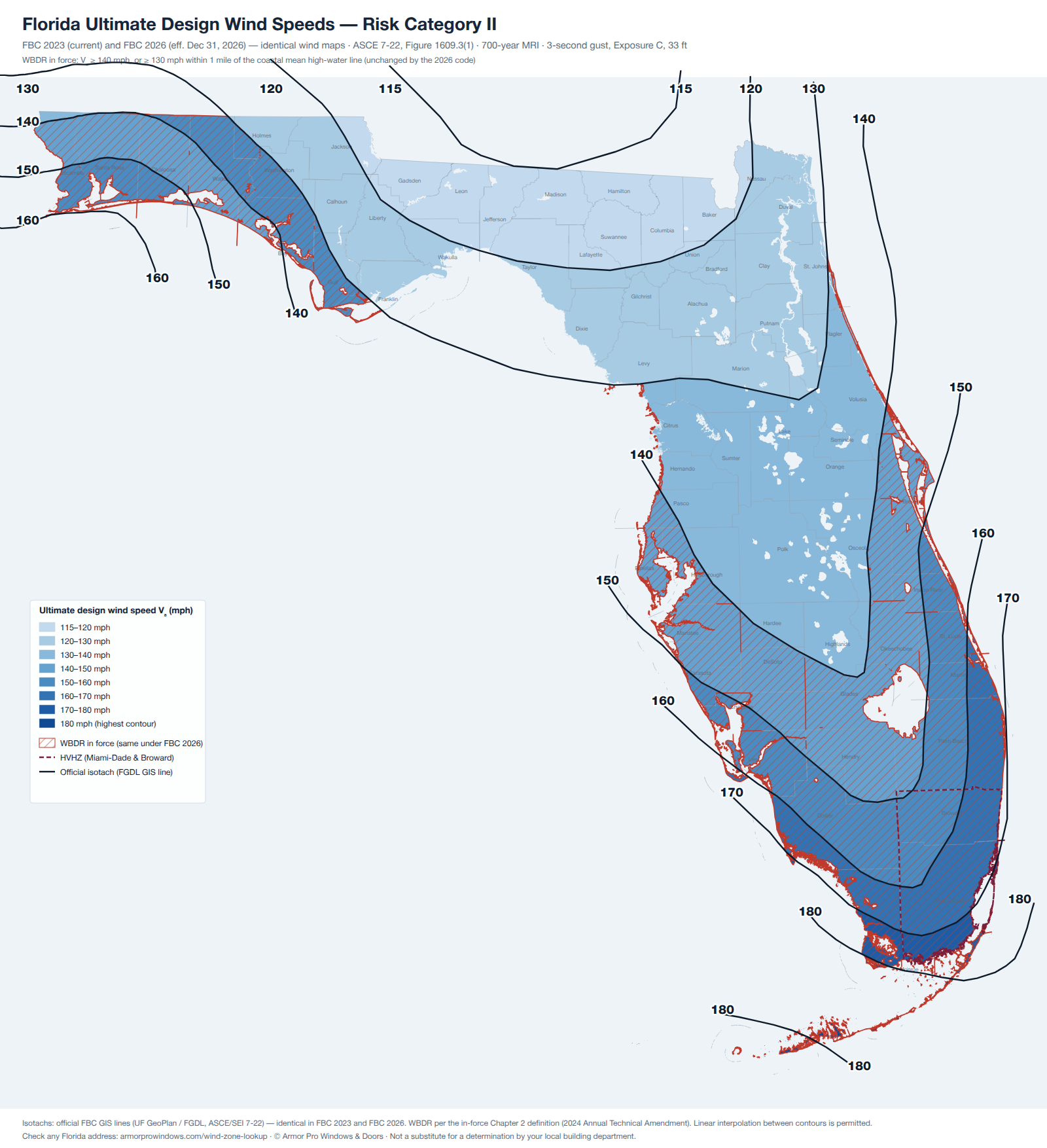
The Wind-Borne Debris Region is the part of Florida where the Florida Building Code requires impact-rated glazing or approved opening protection: everywhere the ultimate design wind speed reaches 140 mph or higher, plus areas at 130 mph or higher within one mile of the coastal mean high-water line. The 2026 code keeps this definition unchanged. (For about seven months in 2024 the trigger briefly extended to large inland lakes under ASCE 7-22 wording, until the Building Commission amended it back — the maps below tell that story.)
The boundary is drawn from the ASCE 7-22 wind speed map, so it follows wind contours rather than county lines: a parcel on one side of a street can carry a different requirement than its neighbor. New construction and additions inside the WBDR must protect every glazed opening with impact-rated products or approved shutters. Replacements in homes built before the Florida Building Code trigger the same requirement once more than 25 percent of the home's glazed area is replaced within 12 months.
The lookup tool above resolves your address against the current map and county boundaries and tells you which side of the line you are on.
High Velocity Hurricane Zone (HVHZ): Miami-Dade and Broward
The High Velocity Hurricane Zone is the Florida Building Code's strictest tier, covering all of Miami-Dade and Broward counties. Every window, door, and shutter installed there must pass TAS 201/202/203 testing (large-missile impact plus 9,000 pressure cycles) and carry a current Miami-Dade Notice of Acceptance or a Florida Product Approval marked for HVHZ use.
Design wind speeds run 175 mph in Miami-Dade and 170 mph in Broward, the highest in the state. The HVHZ sits inside the Wind-Borne Debris Region, and the certification flows one way: an NOA-approved product is accepted anywhere in Florida, while a product approved only for the rest of the state cannot be installed in the HVHZ.
Our guides cover Miami-Dade HVHZ requirements and how HVHZ approval differs from an ordinary impact rating in detail.
Florida Wind Zone Maps for Every Risk Category
Built from the official FGDL GIS lines behind the Florida Building Code’s Figures 1609.3(1)–(4) — the same lines your building department reads, drawn at address scale. The wind maps are identical in the current code and the 2026 edition. Most homes and businesses are Risk Category II, so that map is shown first.
Does the 2026 code move the lines? No — and there’s a story in that
The 2026 Florida Building Code (effective December 31, 2026) keeps both the wind speed maps and the wind-borne debris region exactly as they stand today. But the WBDR’s inland edge has been fought over for three years: the 2023 edition briefly extended the 130–140 mph trigger to large inland lakes under ASCE 7-22 wording, a 2024 technical amendment walked it back, the state commissioned a study that found the inland debris risk is real, and proposals to extend the region again were denied in December 2025.
We cover the whole saga in our report on the inland WBDR expansion proposals and the science behind them. For what the rules mean at your address, the lookup tool above is the fastest answer — it also tells you whether your home sat inside the short-lived 2024 inland designation.
Cartographic derivation from the official FGDL isotach GIS data and the Chapter 2 definitions. Your building department establishes the exact line locations by ordinance. Sources: FBC 2023 as amended (2024 Annual Technical Amendment Supplement 2) / FBC 2026 draft (ICC), UF GeoPlan / FGDL. These maps are free to republish unaltered (CC BY-ND 4.0) with credit to Armor Pro Windows & Doors and a link to this page.