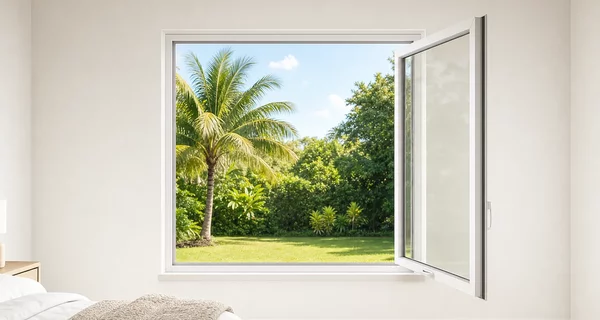
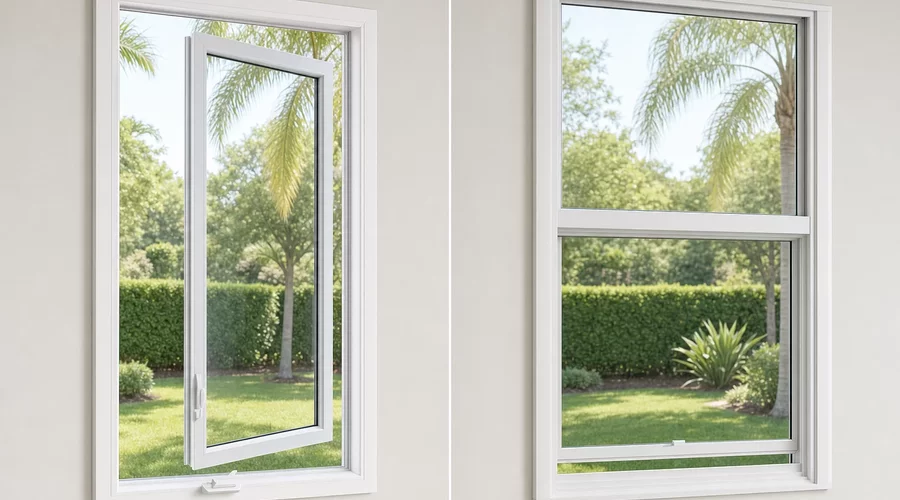

Casement impact windows and single hung impact windows pass the same large-missile tests, but they close in completely different ways, and that difference decides most of the tradeoffs. A casement swings outward on side hinges and pulls its sash into a compression seal when you lock it, which is why casements post the best air and water numbers of any operable window type. A single hung slides its bottom sash vertically past fixed weatherstripping, gives up a little sealing performance, and costs about a fifth less installed.
We install both every week across South Florida, and neither one is the right answer for a whole house. The casement earns its premium on exposed elevations, small bedroom openings, and anywhere wind-blown rain hits the glass head-on. The single hung wins on price, on walkway-facing walls where an outswing sash would catch someone at head height, and on street elevations where the classic two-sash look belongs.
This guide compares the two types on the numbers we can verify: governing design pressures from our approval database, installed prices from our own estimates, water-infiltration test pressures, Florida egress rules, and what a decade of salt air does to crank hardware. If you want the full field of window styles first, start with our impact window types comparison and come back when the choice is down to these two.
How Each Impact Window Closes
A casement window hangs its sash on side hinges and operates with a crank. Turn the handle and the sash swings outward like a door; turn it back and the sash draws into the frame. Locking engages cams at multiple points along the sash, compressing a continuous gasket between sash and frame.
There is no track and no gap for the sash to travel in. The seal is squeezed shut, the same principle a refrigerator door uses.
A single hung window holds a fixed top sash and a bottom sash that slides up in tracks. Weatherstripping rides against the moving sash, and the meeting rail between the two sashes closes against a fourth seal when you latch it. The design has to leave enough clearance for the sash to slide, so the seal wipes rather than compresses.
Both types carry the same laminated impact glass and both go through the same test sequence: a 9-pound 2x4 fired at the glass, then thousands of positive and negative pressure cycles on the cracked unit. The sealing difference shows up before any storm, in everyday air leakage, and during one, in how much wind-blown rain gets past the gasket.
Design Pressure: What Our Approval Database Shows
Across the 53 casement and single hung models in our approval database that carry governing large-missile ratings, we compared each model's worst-case design pressure, stated as magnitudes since the negative (suction) side governs. The result is closer than the casement's reputation suggests.
| Casement models | Single hung models | |
|---|---|---|
| Models with governing large-missile ratings | 20 | 33 |
| Average of each model's max governing DP | 98 PSF | 95 PSF |
| Range across models | 60 to 210 PSF | 50 to 195 PSF |
| Strongest rating in our catalog | +150/-210 PSF (ES Windows HC-200) | -195 PSF (ES Windows 500Y) |
The single highest window rating we sell belongs to a casement: the ES Windows
 ES Windows
Tecnoglass-owned, vertically integrated impact windows and doors with in-house glass and aluminum.
Miami-Dade NOA / HVHZ approved 145 models across 9 product lines
Explore ES Windows
HC-200, an aluminum heavy-commercial unit engineered to +150/-210 PSF. But the averages sit within 3 PSF of each other, and plenty of single hungs out-rate plenty of casements.
The honest read is that structural design pressure is close to a tie in impact-rated product. Almost any quality unit of either type clears the roughly 50 to 80 PSF that South Florida openings actually require. Where the casement's closing mechanism pays off is not the headline DP number. It is the sealing behavior underneath it.
Water and Air: Where the Compression Seal Earns Its Keep
Fenestration products in North America are rated under NAFS, the North American Fenestration Standard maintained by FGIA, which assigns each product air-leakage and water-penetration ratings alongside its structural grade. Casements as a class post the strongest air-infiltration results of any operable type, because a gasket squeezed shut by locking cams leaks less than a gasket a sash must slide across.
The water side of our own records points the same way. Few models publish their water-infiltration test pressure, but among those that do, the one casement, the ES Windows HC-200, passed water testing at 19.5 PSF, while the four single hung models in our data cluster between 12 and 15 PSF. That is a small sample, and we treat it that way, but 15 PSF already corresponds to rain conditions most houses will never see, and the casement tested comfortably beyond it.
There is a mechanical reason the geometry favors the casement in a storm. An outswing sash seats against the frame from the outside, so positive wind pressure pushes it harder into its gasket. A single hung resists the same pressure through its interlocks and tracks, which hold fine structurally but cannot tighten the seal the way direct compression does. If the opening faces open water or takes the brunt of the prevailing wind, that is the elevation where we steer clients toward casement impact windows first.
Egress: Small Openings Favor the Crank
Florida's residential code (FBC R310) requires bedrooms to have an escape opening of at least 5.7 square feet of net clear area, 5.0 square feet at grade floor, with minimums of 20 inches of clear width and 24 inches of clear height. The window type changes how big the window must be to get there.
A casement clears its entire sash area when the sash swings past 90 degrees. A single hung only ever opens its bottom half, so the whole window must be roughly twice the size to net the same clear opening. In the compact bedrooms common to older South Florida houses, that difference decides the choice for you: a casement can satisfy egress in a masonry opening where no single hung of the same size legally can. We cover the sealing and cost tradeoffs here; sizing an actual bedroom opening for egress is worth a conversation with your installer before you commit either way.
Salt Air and Hardware: The Crank Question
The casement's operator is its weak point on the coast. The crank gearbox, the operator arm, the hinges, and the multi-point lock cams are all mechanical parts that live partly outside the air seal, and salt-laden air finds them. Our review of a decade of Florida corrosion research found that airborne chloride drops off steeply within the first few hundred feet of the surf line, but within that band, hardware, not glass or frame, is what fails first.
A single hung has less to corrode: a latch at the meeting rail, balances hidden inside the frame, no external linkage. That is one reason beachfront rental owners who rarely open their windows often default to single hungs and fixed lites.
If you want casements near the water, they can absolutely live there, with two conditions. Order coastal-grade hardware, stainless steel operators and hinges where the manufacturer offers them, and rinse and exercise the hardware a few times a year the same way you would rinse a patio door track. A casement whose crank is never turned is the one that seizes.
Screens, Cleaning, and Daily Use
Day to day, the two types feel different in ways spec sheets never mention:
- Screens. A casement's screen mounts on the interior, since the sash swings out; you crank the window open through it. A single hung's screen sits outside the sliding sash, where it also catches the weather.
- Cleaning. A casement opened to 90 degrees exposes most of its exterior glass to reach from indoors, useful on a second story. On a single hung, the fixed top sash generally means working from outside or with a pole.
- Ventilation. A casement opens its full sash area and an opened sash can scoop a breeze that runs parallel to the wall. A single hung ventilates through half its area at most.
- Clearance. The outswing sash needs somewhere to go. Along walkways, pool decks, patios, and anywhere a shoulder-height sash could meet a passing head, the single hung's in-plane travel is the safer call.
- Effort. Cranks are easier than lifting a laminated-glass sash, which is real weight in impact product. Over a kitchen counter or for anyone with limited shoulder strength, the casement wins on operation alone.
Installed Cost: Casement vs Single Hung Prices
Casements cost more. The operator hardware, the multi-point locks, and the heavier sash engineering all add up, and our own retail numbers show it plainly.
Across the 28 casement models we carry installed-price estimates for, the average estimate runs about $1,200 to $2,600 per window installed. Across 40 single hung models, it runs about $900 to $2,100. At the midpoints that makes the casement roughly 26 percent more per opening.
| Casement (28 models) | Single hung (40 models) | |
|---|---|---|
| Average installed estimate, low end | ~$1,200 | ~$900 |
| Average installed estimate, high end | ~$2,600 | ~$2,100 |
| Midpoint premium | +26% for casement | baseline |
These are our retail installed figures, averaged across manufacturers and tiers; a specific size, glass package, and floor height moves any single quote. On a whole house the practical move is rarely all-casement. Mixing types, casements where sealing and egress matter, single hungs everywhere else, usually lands the budget within reach of an all-single-hung bid while putting the stronger seal where the weather is. Run your own opening count through our impact windows cost calculator to see the spread, and if the delta is the deciding factor, financing spreads it over time rather than forcing the cheaper window on your worst elevation.
Room by Room: Where Each Window Wins
| Opening | Better fit | Why |
|---|---|---|
| Over the kitchen sink | Casement | Crank operation at full reach; no sash to lift |
| Small bedrooms | Casement | Full-sash opening meets egress at smaller sizes |
| Ocean- or canal-facing elevations | Casement | Compression seal against wind-blown rain |
| Walkway, patio, and pool-deck walls | Single hung | No outswing sash at head height |
| Street-facing traditional elevations | Single hung | Classic two-sash look at lower cost |
| Rooms with furniture below the sill | Single hung | Sash stays in plane; nothing swings over the credenza |
| Near-surf homes with low-touch owners | Single hung | Less exposed hardware to corrode |
| Upper floors you want to clean from inside | Casement | Sash at 90 degrees exposes exterior glass |
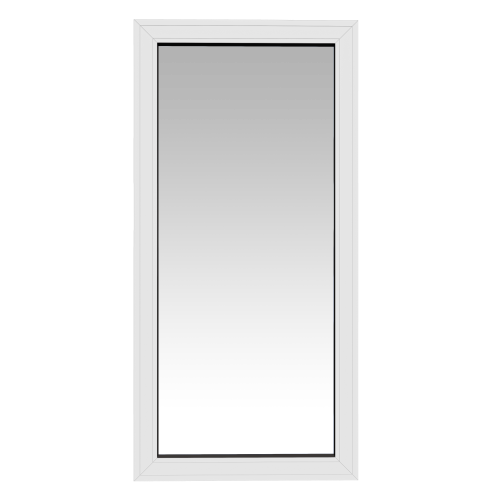
 ECO · Eco-Guard Casement & Awning Series
Eco-Guard Casement Window Series 500
Outswing aluminum impact casement, 2-3/4 in. frame, +70/-75 psf, LMI+SMI, NFRC-certified, with a stainless operator + multipoint lock.
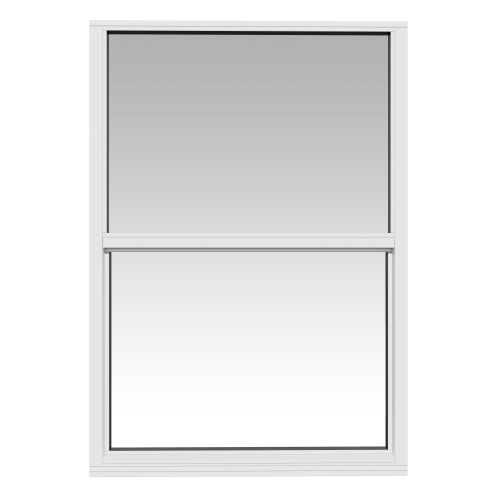 ECO · Eco-Guard Single Hung Series
Eco-Guard Single Hung Series 100
Mid-tier aluminum impact single hung on a 2-3/4 in. frame, +75/-90 psf, LMI+SMI, NFRC-certified, with ultra-lift balances.
Hurricane Season With Each Window
When a storm is coming, both windows want the same thing: closed and fully locked. On a casement that instruction matters twice, because the compression seal only reaches full squeeze when every lock cam is engaged, and a sash left cranked open even an inch in a squall is a sail on a hinge. Walk the house, crank each sash home, and throw every lock, not just the handle-side one.
Before the season, give casement hardware five minutes per window: cycle the crank through its full travel, confirm the lock points seat without force, and rinse coastal hardware with fresh water. On single hungs, check that the meeting-rail latch pulls the sashes together snugly and that weep holes at the sill are clear so the frame can drain.
Neither type needs shutters. Both carry Florida product approvals and Miami-Dade NOAs as impact product; if you want to see what stands behind a rating, the Miami-Dade NOA installation document for PGT's CA-740 aluminum casement (NOA 23-0816.12, active through 2028) shows the tested sizes, glass makeups, and anchoring the approval is conditioned on. The protection is in the tested assembly, whichever way the sash moves.
Next Steps
If you are down to casement vs single hung on a real set of openings, the fastest way to settle it is to price both. Request a free estimate and we will measure each opening, flag the bedrooms where egress decides the type for you, and quote the mix both ways so you can see exactly what the compression seal costs on your elevation count.