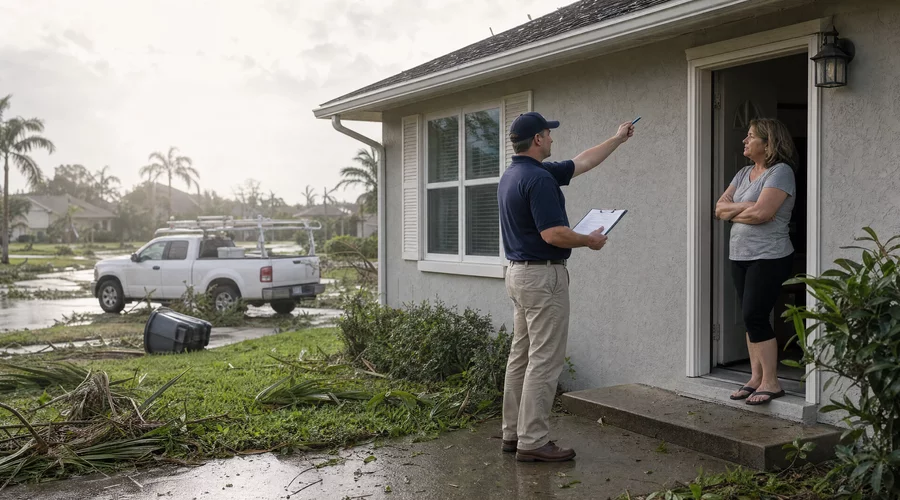

Post-storm contractor scams are not improvised crimes of opportunity; they are a traveling business model with a schedule, a script, and a route that follows landfall coverage from county to county. The crews knocking on damaged doors three days after a hurricane have run the same play in four states, and it works because storm-shocked homeowners face them without the two things that defeat the script: knowledge of the specific laws involved, and a two-minute verification habit.
This guide supplies both. It pairs each standard scam with its tell and its legal counter, then lays out the clean path to a legitimate repair. It belongs to our aftermath series alongside the first-72-hours guide and the insurance claim walkthrough.
Why the Scams Work (For a While)
The post-storm environment is engineered for bad decisions: visible damage creating urgency, legitimate contractors booked out weeks, insurance processes most people run once a decade, and a yard full of debris announcing vulnerability to every passing truck. Fraud rings staff up for exactly this window. The Florida counters exist because the legislature has watched this movie annually for decades, and the reforms since 2022 removed the scam economy's favorite instrument entirely. Knowing four laws converts you from mark to dead end:
| The law | What it does for you |
|---|---|
| AOB ban (SB 2A, for policies issued after Jan 1, 2023) | Nobody can take over your insurance claim by signature |
| F.S. 489.126 deposit rules | >10% up front obligates a permit application within 30 days, work within 90 days of permits |
| License verification at MyFloridaLicense.com | Every legitimate contractor is checkable in two minutes |
| F.S. 501.160 price gouging | Emergency-period gouging is illegal; 1-866-9-NO-SCAM |
The Eight Standard Scams and Their Tells
1. The canvasser with a today-only price. The knock comes days after landfall, often with "we're already doing three houses on this street." The tell is manufactured urgency: real post-storm demand runs the opposite direction, with legitimate installers booked out and no need to discount anything. Any price that expires when the truck leaves was never a price; it was a hook.
2. The deposit artist. Half up front "for materials," then a missed start date, then a disconnected number. Florida law is unusually specific here: a contractor taking more than 10% of the contract price on residential work must apply for necessary permits within 30 days of payment and start work within 90 days of permit issuance. The criminal exposure scales with the money: keeping funds without performing is graded from a misdemeanor under $1,000 up through a second-degree felony between $20,000 and $200,000, which is exactly where a typical whole-home window deposit lands, with civil treble-damages exposure on top. Legitimate local contractors either stay at or below 10% or cheerfully explain their permit timeline in writing. Storm-chasers need your deposit precisely because they never intend to pull a permit.
This is not a theoretical statute. When Palmetto's Mister Window collapsed, a Manatee County court entered a March 2026 judgment of $24,089.36 for a customer who had paid an $18,000 deposit and, in the court's words, received no work, no materials, and no windows; the company's own supplier sued for another $51,783.35 in unpaid invoices, and more than 40 complaints reached the Attorney General (DWM Magazine's reporting traces the cascade). The pattern to memorize from that collapse: missed permit deadlines, then unpaid suppliers, then supplier liens landing on customers' homes — homeowners who paid in full can still end up with a lien, which is why the permit-and-payment paper trail matters from day one.
3. The AOB revival act. Paperwork that assigns your insurance benefits "so we can handle everything with the carrier." This was the engine of a decade of Florida claim fraud, and it is dead: assignment of benefits is banned for residential property policies issued on or after January 1, 2023. The pitch survives because it sounds convenient. Treat any AOB form as a self-identifying red flag; the modern legitimate equivalents (a direction-to-pay for finished work, your own public adjuster) leave the claim in your name, as our claim guide explains.
4. The deductible eater. "We'll waive your deductible" or "we'll invoice the insurer high enough to cover it." Understand what is being proposed: inflating an insurance claim to conceal a rebate, which is insurance fraud, on a claim that carries your signature, not theirs. Florida's contractor-solicitation law (F.S. 489.147) treats this so seriously that contractors whose ads touch insurance claims must disclose, in prescribed type, that paying or waiving a deductible is a third-degree felony — and the same law bans offering gifts, rebates, or anything of value in exchange for letting them inspect or file a claim. When the ring is prosecuted later (they are, routinely), the customer file is the evidence. The offer also tells you the real bid is padded by at least the deductible.
Two adjacent protections travel with that statute. Contracts signed based on a declared state of emergency carry a 10-day cancellation right, and the successor pitch to the dead AOB, "just let us handle the whole claim with your insurer," has its own tripwire: negotiating an insurance claim on your behalf without a public adjuster license is a felony under Florida's unlicensed-adjusting law. A contractor can accept insurance proceeds as payment and hand you paperwork; the moment they argue scope or settlement with your carrier, they have left their lane.
5. The unlicensed "crew that just did your neighbor's." Unlicensed contracting spikes after every storm, and hiring them costs more than the shoddy work: unpermitted repairs fail at resale, void manufacturer warranties, can complicate your insurance claim, and leave you no license board to complain to. Every legitimate license, from general contractor to specialty glazing, verifies at MyFloridaLicense.com in less time than the sales pitch took. Unverifiable license number, "license pending," or a borrowed number that does not match the business name: walk away. Unlicensed contracting during a state of emergency is itself a felony in Florida.
6. The tarp-and-vanish crew. Emergency tarping or board-up at an astonishing price, cash preferred, sometimes "billable to your insurance" at triple rates. Emergency mitigation is genuinely reimbursable (with receipts), which is the hook the inflated version hangs on. Gouging on emergency services and materials during a declared state of emergency violates F.S. 501.160; document the quote and report it to the Attorney General's hotline at 1-866-9-NO-SCAM or the NO SCAM app.
7. The inspection inventor. A "free storm inspection" that discovers damage invisible to you, urgent and expensive, sometimes created on the spot. Broken windows announce themselves; subtle opening damage exists (seal breaches, racked frames) but is diagnosable and photographable. The counter is a second opinion from a contractor you called, and skepticism proportional to how badly the finder wants to also be the fixer. This is the inspector-contractor conflict of interest that even the state's own My Safe Florida Home program is structured to prevent.
8. The permit hand-off. The crew that asks you to pull an owner-builder permit "to save time and money." Florida's owner-builder exemption exists for homeowners genuinely acting as their own contractor, with personal, on-site supervision, and the Attorney General has documented "owner-builder fronting" as a standard unlicensed-contractor move: the permit falsely implies you are supplying the labor, and every bit of code liability lands on you. If the work fails inspection or the crew vanishes, the building department's remedies run against the homeowner on that permit. A contractor who cannot pull a permit under their own license is telling you exactly what their license situation is. Related tell: post-storm, the "permits take months, we should just start" excuse fails on its face, because F.S. 553.7922 requires building departments to expedite hurricane-repair permits during the emergency period.
Anatomy of a Deposit Scam, Week by Week
Abstract warnings slide off; a timeline sticks. Here is the standard deposit scam as it actually unfolds, assembled from the pattern that county consumer-protection offices document after every landfall.
Week 1. The knock, three days post-storm. Magnetic sign on the truck (magnets travel between company names), out-of-county plate, a clipboard photo of "your neighbor's contract." The quote is plausible, not absurd; sophisticated crews price near market because absurd prices trigger caution. The ask: 40-50% down "to order materials before the manufacturer backlog," today only.
Week 2-3. Reassurance theater. A crew appears once, tears something off or drops a pallet of material (often not the right material; sometimes rented for the day), which converts the job from "not started" to "underway" in the homeowner's mind and complicates a clean cancellation. Calls still get answered.
Week 4-6. The stall. Materials are "stuck in the backlog," the permit is "in review" (no application exists; this is checkable at your building department's portal in five minutes), the crew is "finishing another job." Calls route to voicemail. The certified-letter clock under F.S. 489.126 has been running since the deposit: past 30 days without a permit application, the statute's presumptions start working for you.
Week 7+. The vanish, or the squeeze: either the company dissolves (the license, if any, belonged to someone else), or a new face appears offering to "finish the abandoned job" for a second payment. By now the legitimate installers the homeowner passed over in week one have worked through their backlog and are installing for the neighbors who waited and verified.
Every stage of this has a cheap exit: the permit-portal check in week four, the certified demand letter at day 31, the license search before the first dollar. The expensive exit is the one at week seven. Take the earliest one available, and report the pattern to DBPR either way; these files aggregate into the prosecutions.
The Paperwork Checks Florida Hands You
Before the verification habit, know the three pieces of paper Florida law already requires, because their absence is itself the tell.
The license number on everything. Under F.S. 489.119(5)(b), a contractor's license number must appear in every offer, proposal, bid, contract, and advertisement, and the state's rules spell out that "advertisement" includes door hangers, flyers, business cards, yard signs, websites, and social media; a companion subsection requires it displayed legibly on every marked work vehicle. DBPR investigators photograph trucks at job sites for exactly this reason. A door hanger or truck with no license number is a first-order red flag with a named statute behind it.
The cancellation block in the contract. A door-to-door sale is a "home solicitation sale" under Florida law, and the contract must carry a conspicuous notice captioned "BUYER'S RIGHT TO CANCEL" giving you three business days (Saturdays count; Sundays and federal holidays do not) to cancel by written notice, postmark sufficient. Check your own paperwork for that exact caption. Here is the part almost nobody knows: if the notice is missing or defective, your cancellation clock never started. A deposit handed over months ago under a contract without the required block is still recoverable on demand, and the notice failure itself is a misdemeanor, felony on repeat.
The county solicitation permit. Door-to-door sellers are required to hold a home-solicitation-sale permit from the clerk of the circuit court in the county where they knock (sales you expressly invited are exempt). Asking the knocker for their county solicitation permit is a perfectly fair question that ends most driveway pitches on the spot.
The Two-Minute Verification Habit
Before anyone touches your home, four checks, all free:
- License: search the exact business name and license number at MyFloridaLicense.com — and read past the status line. The record shows expiration, the qualifying agent, and public discipline history; a license that is "active" but qualified by a stranger with a discipline record is its own warning.
- Insurance: ask for the certificate of liability and workers' comp. A crew member injured on your property without comp coverage becomes your problem.
- Locality: a Florida address, a local permit history, references from before this storm. "We follow the storms" is a disqualifying answer for permanent work, whatever it means for tarps.
- Paper: written scope, written price, written timeline, permit responsibility named, deposit at or under 10% or a written permit schedule that satisfies 489.126.
Legitimate contractors pass these checks without friction; most fail at step one. The checks also filter the merely disorganized, which matters because a storm repair that skips permits fails you almost as thoroughly as a fraud: replacement windows and doors in the Wind-Borne Debris Region must be impact-rated or protected to current code, and the permit-and-inspection trail is what proves it to your insurer, your wind-mitigation inspector, and your eventual buyer.
A closing note on scope creep from the other direction: post-storm canvassers rarely sell one trade. The roofer discovers your windows, the window guy discovers your roof, and the bundle price arrives before any license for the second trade does. Florida licenses are trade-specific; verify each trade being sold, and treat a bundle assembled in your driveway with the same skepticism as any other today-only construction.
The Enforcement Reality, in Numbers
The state does act, and the sweep statistics are worth knowing because they define both the protection and its lag. After Helene and Milton, a two-week Pinellas County operation in November 2024 apprehended more than 50 people for unlicensed contracting; a two-day Lee County sting in January 2025 charged nine, with felony state-of-emergency enhancements. Across 2025, DBPR processed 22,003 complaints, ran 853 unlicensed-activity sweeps and stings, and paid homeowners $4.35 million from the Construction Recovery Fund.
The lag is the lesson. Tracking named Florida window-company collapses shows Attorney General investigations typically open around 30-40 accumulated complaints, by which point 30-40 households have already lost their deposits. In the Sarasota Sash & Sill bankruptcy, 117 customers were holding paid deposits on unfinished jobs totaling $1.3 million when Chapter 7 arrived. The state's machinery is real; it is just slower than your verification habit needs to be.
If You Already Signed Something
Move fast; the law gives you more room than the scammer implied.
- Deposit paid, no permit, 30 days passing: send the contractor a written demand by certified mail, return receipt requested, to the address on the contract. The statute is built around that letter: 30 more days of inaction lets a court infer the contractor had no just cause, which is what converts a civil dispute into criminal exposure. Then report to the DBPR and your county licensing board.
- Scammed by a LICENSED contractor: the Florida Homeowners' Construction Recovery Fund is real money — contracts over $2,500 must even carry a notice about it — and the caps rose in 2024 to $100,000 per claim for Division I contractors. A DBPR complaint plus a judgment or restitution order is the path in; the fund paid homeowners $4.35 million in 2025.
- Any post-storm contract you want reviewed: the state's "Check My Contract" portal, launched after Milton, routes homeowner contracts to state reviewers and feeds investigations. Free, and the review itself sometimes shakes the contract loose.
- AOB signed on a post-2023 policy: it is void as against the statute; notify your carrier in writing immediately so the claim stays in your control.
- Work started and it is bad or unpermitted: stop payment on anything remaining, document the state of the work photographically, and get a licensed contractor's written assessment before anyone "fixes" the evidence.
- Gouged on emergency services: receipts and quotes to 1-866-9-NO-SCAM; the AG's office builds cases from exactly these reports.
- In every case: your insurer's fraud line wants to hear about deductible schemes and inflated invoices before payment, not after.
The Clean Path, For Contrast
The legitimate post-storm repair sequence is unglamorous: document and mitigate, file the claim, choose a contractor by verification rather than by knock, contract with clear scope and lawful deposit, permit, install, inspect, collect the paperwork. It is slower than the man in the driveway promised, and every week of it is recoverable, which the alternative is not. If the storm retired your openings, get a measured free estimate from a local, verifiable installer and let the claim and financing carry the code-compliant version of your home.
Next Steps
- Save the two numbers now: MyFloridaLicense.com for verification, 1-866-9-NO-SCAM for gouging, before the season needs them.
- Run the two-minute verification habit on anyone who bids, knocks, or tarps.
- Keep your claim in your own name; the claim guide covers the legitimate escalation ladder.
- Handle urgent openings with the board-up guide and receipts, not the loudest truck on the street.
- For permanent repairs, get a measured free estimate from a verifiable local installer, and compare against your prep-season options rather than the driveway price.