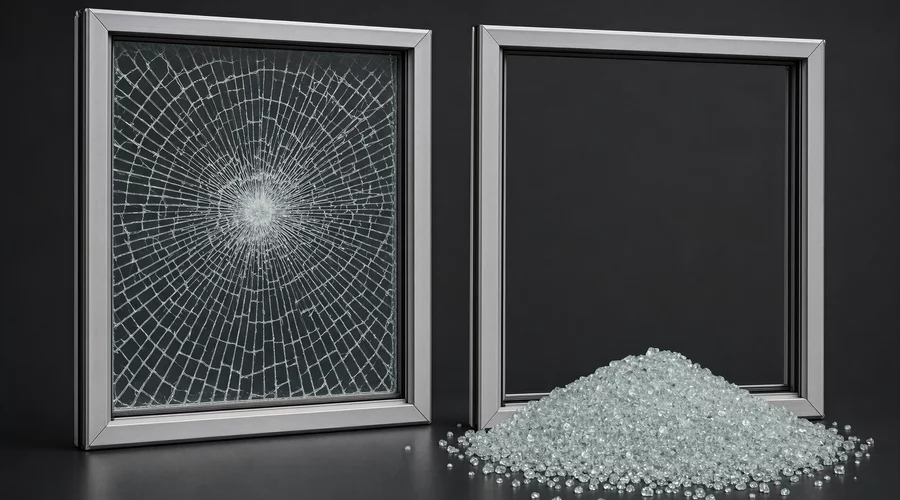

Laminated glass and tempered glass solve two different problems. Tempered glass is heat-treated to be roughly 4 to 5 times stronger than ordinary annealed glass, and when it finally breaks it crumbles into small, blunt cubes instead of dagger-like shards. Laminated glass bonds two sheets of glass to a tough polymer interlayer, so a broken pane cracks but stays in one piece, still sealed in its frame.
That one difference, what happens after the break, decides everything else. It decides which one your shower door uses, which one your windshield uses, and which one the Florida Building Code accepts on the outside of your house during a hurricane. Tempered glass alone is not hurricane protection. It passes federal safety-glazing tests, and it fails the large-missile impact test the moment its dice-pattern break dumps the whole pane out of the opening.
We install laminated impact glass every working day in South Florida, and we still spec tempered glass all the time: in shower enclosures, in interior glass, and even inside certain laminated makeups. This guide covers how each type is made, how each breaks, what each does for sound, UV, and security, where codes require each one, and why the hurricane question has only one answer.
The figures below come from the glazing materials database we maintain for spec work: 43 sourced interlayer properties plus glass-type, missile-test, and acoustic tables. Every row traces back to the manufacturer data sheet, test standard, or lab report that published it.
How Tempered Glass Is Made
Tempered glass starts as ordinary annealed float glass. A tempering furnace reheats the cut pane to about 1,200°F, then quenches both faces with cold air. The surfaces harden while the interior is still hot; as the interior cools and contracts, it pulls both surfaces into permanent compression.
That locked-in stress is the whole trick. Glass fails in tension, and a surface already squeezed in compression has to have that squeeze overcome before any tension can build. Under ASTM C1048, fully tempered glass (Kind FT) must carry at least 10,000 psi of surface compression, per Vitro's TD-138 heat-treated glass data. The payoff is a pane about 4 to 5 times stronger than annealed glass of the same thickness.
The locked-in stress is also why nobody can cut, drill, or edge-grind a tempered pane after tempering. Any breach of the compression envelope releases the stored energy all at once, which is exactly what its famous break pattern is.
How tempered glass breaks: the dice pattern
When a tempered pane fails, the stored stress tears the entire sheet into small, roughly cubical granules in a fraction of a second. The industry calls it dicing. The cubes have blunt edges and rarely cause the deep lacerations that annealed shards do. That is how tempered glass earned the name "safety glass."
Then watch what happens next: the cubes do not stay put. They pour out of the frame, the pane evacuates the opening, and whatever the glass was keeping out now has a clear path in. Published post-breakage research in our database (Fractan) puts the equivalent stiffness of a broken tempered ply at about 10 GPa, versus about 25 GPa for broken heat-strengthened glass. That is roughly 14% of intact stiffness against 36%. A broken tempered lite inside a laminate sags like a wet blanket. A broken monolithic tempered pane is simply gone.
Tempered glass is also the only glass family subject to nickel-sulfide inclusion breakage, a rare internal defect that can shatter a pane spontaneously, years after installation, with no impact at all.
How Laminated Glass Is Made
Laminated glass is a sandwich: two or more glass plies permanently bonded to a polymer interlayer, which in hurricane products means polyvinyl butyral (PVB) or a stiffer ionoplast sheet. The idea dates to a French chemist who noticed a celluloid-coated flask crack without scattering; PVB has been the standard interlayer since 1938.
The bond is made in an autoclave at about 280°F and 180 psi, where heat and pressure fuse the polymer to the glass. The finished unit looks and handles like a single pane.
Thickness is where hurricane laminates part ways with your windshield. A car windshield typically carries a 0.030-inch PVB interlayer. Hurricane impact glass is built on 0.090 inches of PVB, three plies laminated together, or on ionoplast interlayers such as Kuraray's SentryGlas. The glass plies themselves can be annealed, heat-strengthened, or tempered, a choice we cover below.
How laminated glass breaks: crack, stretch, hold
Hit a laminated pane hard enough and the outer glass ply cracks. At that moment the interlayer takes over. Eastman's technical sheet for Saflex Clear PVB lists an elongation at failure of 270% (ISO 527-3): the film stretches to nearly three times its length before tearing, soaking up the missile's energy as it deforms. Kuraray's SentryGlas ionoplast runs to 400%.
The broken glass goes nowhere. Fragments stay bonded to the interlayer through the same adhesion that made the laminate, and the cracked panel stays sealed in the frame, keeping wind, rain, and debris outside. In the Fractan post-breakage testing, a laminate with one broken ply keeps about 60% of its intact strength, and even with both plies broken it holds 18 to 22%.
Impact-rated products then have to prove it. Miami-Dade's TAS 203 protocol cycles the already-cracked assembly through 9,000 alternating positive and negative pressure loads, and the interlayer is not allowed to tear open.
Laminated vs. Tempered Glass Side-by-Side
| Property | Tempered glass | Laminated glass |
|---|---|---|
| Strength vs. annealed | About 4-5x (ASTM C1048 Kind FT) | Set by the plies used (annealed through tempered) |
| Break pattern | Whole pane dices into small blunt cubes | Cracks radiate; fragments stay bonded to the interlayer |
| Stays in the opening after breaking | No, the pane falls out | Yes, cracked panel stays sealed until replaced |
| Safety glazing (CPSC 16 CFR 1201) | Yes | Yes |
| Large-missile impact rating (ASTM E1996 / TAS 201) | No, not as a monolithic pane | Yes, in tested assemblies |
| Sound rating at ~1/4-inch makeup | STC 31 (monolithic pane; heat treatment does not change it) | STC 35 (1/8-inch + 0.030 PVB + 1/8-inch) |
| UV blocked | Little of the UVA range | 99%+ with a PVB interlayer |
| Forced entry | One solid strike clears the opening | Resists repeated blows; glass clings to the interlayer |
| Cutting after manufacture | Never | Possible on annealed-ply laminates, by a fabricator |
| Typical home uses | Showers, interior doors, furniture, non-impact sliders | Impact windows and doors, high-rise glazing, windshields |
The sound figures come from Riverbank Acoustical Labs testing in our acoustic table: a 1/4-inch monolithic pane rates STC 31, while a laminated makeup of two 1/8-inch lites over 0.030 inches of PVB, barely thicker overall, rates STC 35. The soft interlayer damps vibration that a solid pane passes straight through.
Safety Glazing Is Not an Impact Rating
This is the distinction that trips up most homeowners, and it is worth getting exactly right.
Safety glazing is a people-protection standard. The federal rule, CPSC 16 CFR Part 1201, governs glass in hazardous locations: doors, sidelites beside doors, tub and shower enclosures, and other glass a person could walk or fall into. Its job is to keep a human body from being badly cut. Both tempered and laminated glass can be certified to it.
An impact rating is a building-protection standard. ASTM E1996 defines the wind-borne debris threat by missile level. Under level D, the workhorse requirement for habitable openings in the High-Velocity Hurricane Zone, the lab fires a 9-pound 2x4 stud into the glazing at 50 feet per second, about 34 mph and roughly 350 foot-pounds of energy. The assembly takes hits at two locations, then endures the pressure cycling described above with the glass already cracked. Above 30 feet, where lumber rarely flies, a small-missile test substitutes 2-gram steel balls fired at 130 feet per second, about 89 mph.
A monolithic tempered pane can pass 16 CFR 1201 all day and still has no path through ASTM E1996. The first 2x4 that connects turns it into a pile of cubes on the floor, and nothing is left to face the pressure cycles. A "safety glass" etch in the corner of a pane says nothing about hurricanes—if you are not sure what is actually in your frames, here is how to tell whether your existing windows are impact-rated.
Where Building Codes Require Each One
Safety glazing (tempered or laminated). The Florida Building Code, following the national model codes, requires safety glazing in hazardous locations: glass in doors, glass within reach of a door swing, tub and shower surrounds, and large panes close to the floor. Either glass type satisfies this. Your shower enclosure is tempered because dicing is exactly what you want an arm's length from bare skin.
Impact protection (laminated or shutters). In Florida's wind-borne debris regions, every glazed exterior opening must either carry an impact rating or be protected by a rated covering such as shutters. The High-Velocity Hurricane Zone (Miami-Dade and Broward counties) enforces the strictest version through TAS 201/202/203 testing. You can check which wind zone applies to your address with our wind zone lookup.
Both at once. A glazed entry door in the HVHZ has to satisfy the safety-glazing rule and the impact rule in the same panel. Laminated glass is the answer to both: it is a listed safety glazing under 16 CFR 1201 and the only glazing that survives E1996.
Hurricane Wilma in 2005 wrote the case study. High-rise facades glazed in monolithic tempered glass shed panes by the hundreds; the falling cubes and gravel became missiles for the floors below, and failures cascaded across whole elevations. Florida's 2007 code revision responded by requiring laminated glass above 30 feet.
Sound, UV, and Security: The Differences You Live With
Sound. The STC numbers in the table above are the honest version of a claim you will see everywhere: laminated glass is quieter than monolithic glass of similar thickness because the viscoelastic interlayer damps vibration. Acoustic PVB variants, built with a softer middle layer, add another 2 to 4 STC points beyond what the glass mass alone earns. Tempering changes strength, not sound; a tempered pane is acoustically the same as annealed.
UV. A standard PVB interlayer blocks 99%+ of ultraviolet light, per Kuraray/Trosifol and Eastman technical documentation. That is fading protection for floors, furniture, and artwork that a monolithic tempered pane, which passes most of the UVA range, does not offer.
Security. A tempered pane is defeated in one strike; a spring-loaded punch clears the whole opening in about a second, quietly. Laminated glass fails differently: each blow cracks more glass, and every fragment stays stuck to the interlayer, so an intruder has to batter and cut a hole through a clinging, rubbery sheet while making noise the entire time. We have covered where the upper limits sit in what it takes to actually defeat impact glass.
Where Tempered Glass Still Belongs
None of this makes tempered glass obsolete. It is the right product wherever human contact, not flying debris, is the design threat:
- Shower and tub enclosures, where wet skin and hard falls make the dice pattern the safest possible failure.
- Interior glass: partitions, interior doors, cabinet and furniture glass, stair-adjacent panes.
- Non-impact exterior windows outside the wind-borne debris region, where code asks only for safety glazing in hazardous locations.
- Inside impact assemblies. Some laminated makeups use a tempered or heat-strengthened outer lite for extra pre-breakage strength, and small-missile high-rise glazing pairs a tempered outer lite with a laminated inner lite.
One nuance from the fabrication side: for large-missile laminates, the industry generally prefers heat-strengthened glass (Kind HS, 3,500 to 7,500 psi surface compression, about twice annealed strength) over fully tempered. Its larger broken fragments interlock and grip the interlayer far better than tempered dice, which is what those broken-ply stiffness numbers, 25 GPa against 10, are measuring.
The Florida Bottom Line: Hurricane Protection Means Laminated
If you remember one thing, make it this: strength before the break is the wrong question. A hurricane opening is judged by what it does after the glass cracks, and that is a contest tempered glass cannot enter, because its entire safety mechanism is leaving the frame.
Laminated impact glass cracks, stretches, hangs on, and keeps carrying pressure loads with both plies broken. That is what the 2x4 test and the 9,000 cycles are certifying, and it is why every rated product on our impact windows line is laminated regardless of which plies or interlayer it uses. The makeup inside that laminate, glass thicknesses, interlayer chemistry, Low-E coatings, insulated units, is its own topic, and we walk through it in impact window glass, explained.
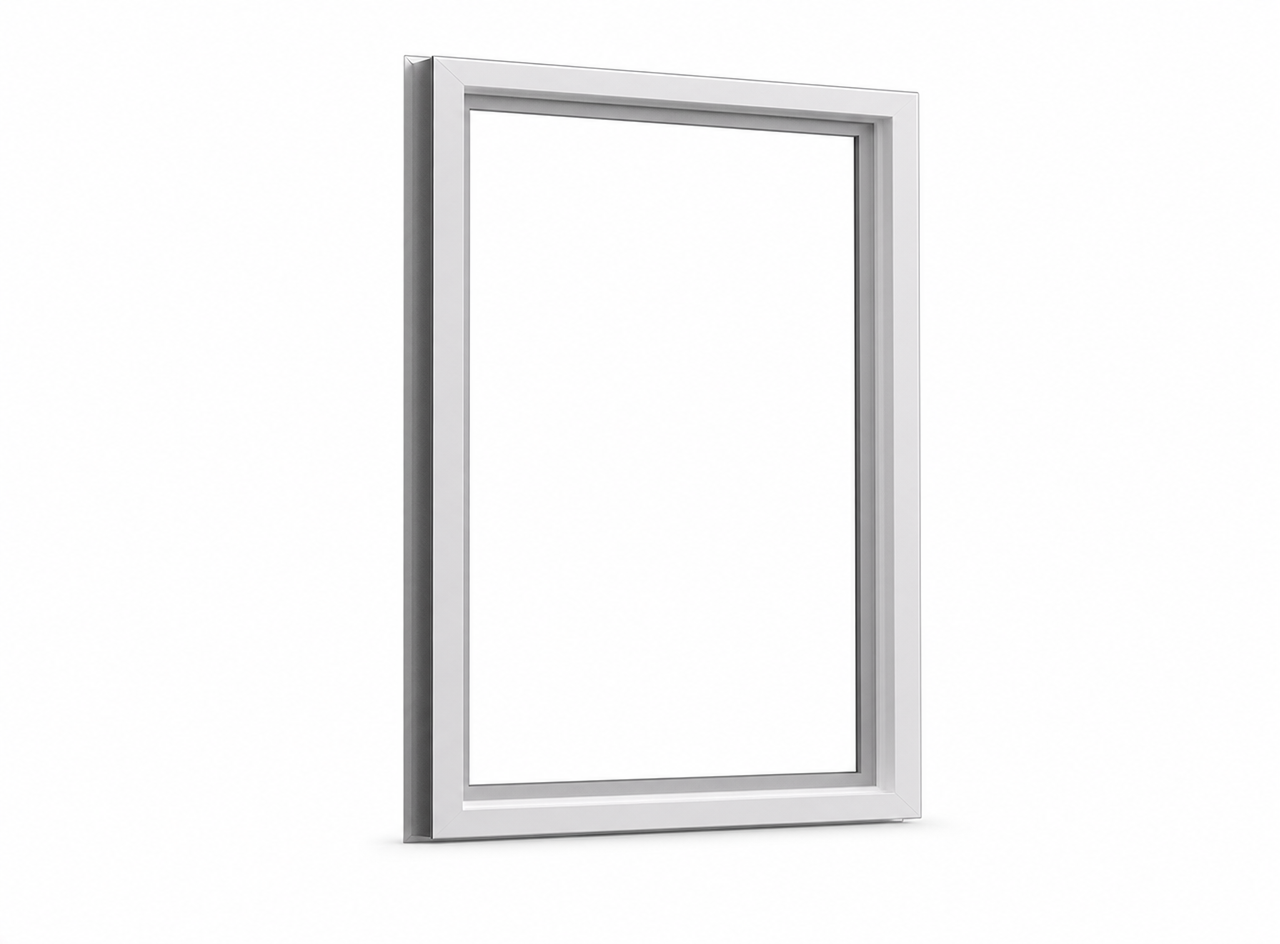
 PGT · WinGuard Aluminum Series
PGT WinGuard Aluminum Casement Picture PW740A
Aluminum impact casement-companion picture window that mulls seamlessly with CA740A and AW740A in the 740-family for multi-window assemblies.
 ECO · Eco-Guard Architectural Fixed Window Series
Eco-Guard Architectural Fixed Window Series 70
Entry aluminum impact fixed window, 2-1/8 in. frame, +60/-60 psf, LMI, up to 32 x 104 in.
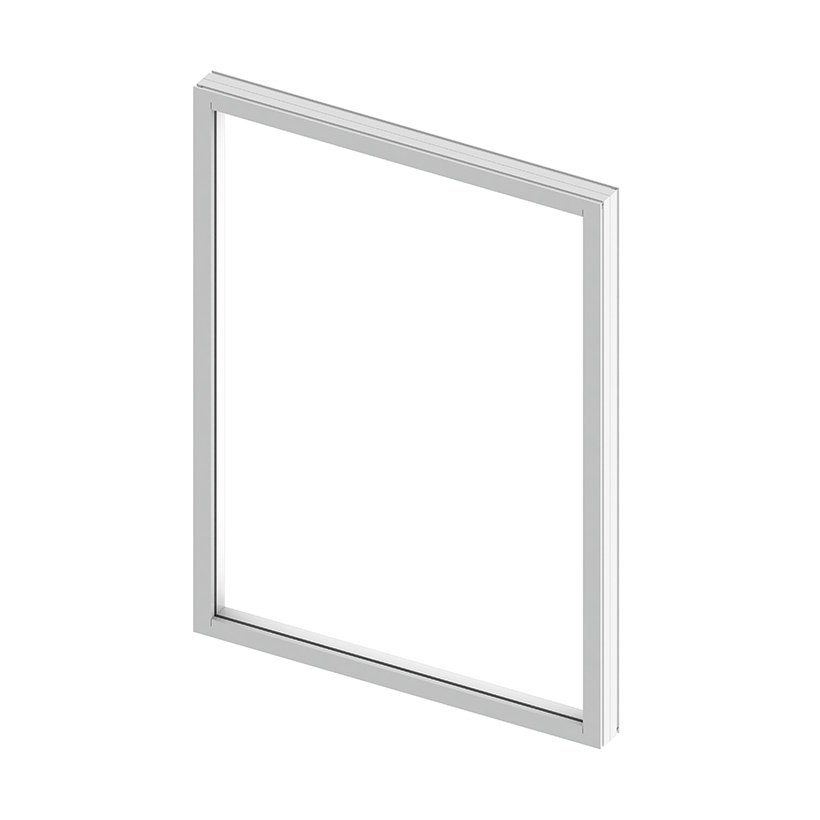
 ES Windows · Elite Series
ES Windows Elite ES-EL150 Fixed Window
Aluminum impact fixed window on a 2-15/16 inch frame, matching the rest of the Elite residential line for clean sightline continuity.
Next Steps
If you are weighing glass options for a Florida home, the choice is already made for the exterior: code and physics both point to laminated impact glass, and the real decisions are makeup, interlayer, and frame. Request a free estimate and we will spec the right laminated configuration for your openings, your wind zone, and your budget.