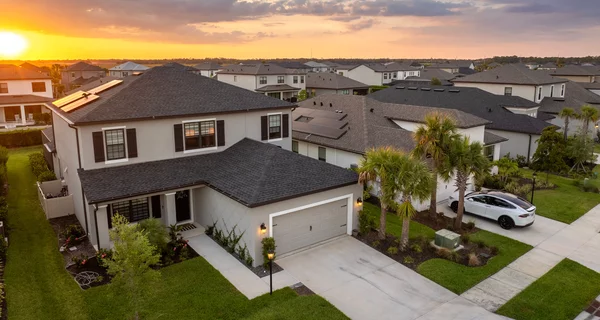
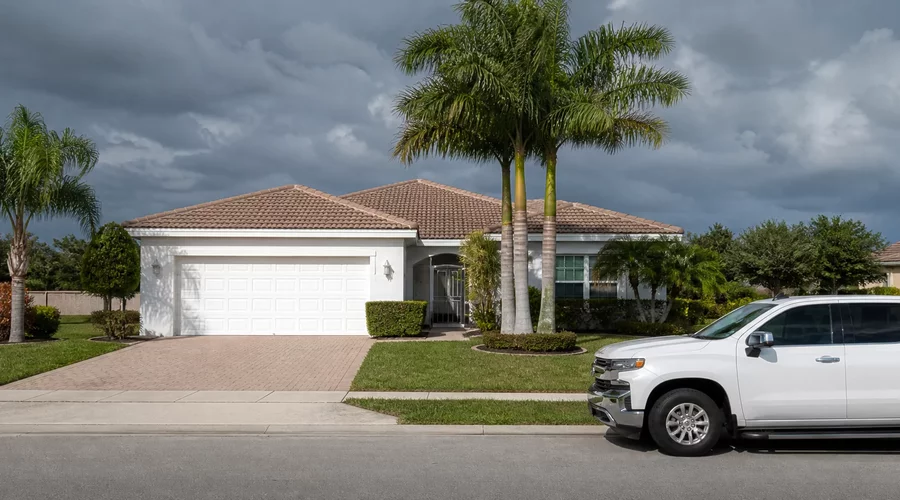

Florida's garage door wind code exists because the garage door is the largest opening on the house and the one under the most structural demand in a storm. A standard 16-by-7 double door presents more than 112 square feet of surface to the wind. At a design pressure of 50 PSF, that single moving panel is resisting roughly 5,600 pounds of load.
We wrote previously about why garage doors are the weakest link in a home's hurricane protection, and about choosing a hurricane garage door. This article covers the layer underneath both: what the code actually requires, how the ratings work, and how to check the door you already own.
Why the Code Singles Out Garage Doors
The engineering problem is simple physics. Wind load scales with area, and no other opening comes close to a garage door's area. Worse, a failed garage door does not just let rain in; it pressurizes the building. Once storm winds enter through a failed door, internal pressure pushes up on the roof deck and out on the walls, and roof loss frequently follows. Post-storm damage assessments have told this story since Hurricane Andrew in 1992, which is why the modern code treats the garage door as a structural component, not a convenience.
That history shaped two separate requirements every Florida garage door must satisfy: a pressure rating (the door stays in its tracks under sustained wind load) and, in the state's most exposed zones, an impact rating (the door survives windborne debris). Understanding which of the two applies to your address is most of understanding the code.
What the Florida Building Code Requires
For a replacement or new garage door in Florida, the requirements come down to four things:
- A permit. Garage door replacement is permitted work in Florida. The door is a structural wind component, and the permit is how the jurisdiction verifies the product and its attachment.
- A product approval. The door model must carry a Florida Product Approval (an FL number in the state database) or, in Miami-Dade and Broward's High-Velocity Hurricane Zone, a Miami-Dade Notice of Acceptance (NOA).
- Pressure ratings matched to the site. The door's design pressure rating must meet or exceed the wind loads calculated for your address, exposure, and opening size.
- Installation per the approved instructions. The approval covers the door plus its track, fasteners, and attachment schedule as a system. Substituting hardware or spacing takes the installation outside its approval.
The code edition in force is the Florida Building Code 8th Edition (2023). Its wind provisions derive design loads from ASCE 7 wind speed maps, which is where the regional numbers below come from.
Design Wind Speeds by Region
Design wind speed is the starting input for your door's required rating. These are the FBC 8th Edition design speeds (3-second gust, Risk Category II) across Florida:
| Region | Design wind speed |
|---|---|
| Florida Keys (Monroe) | 170-190 mph |
| Miami-Dade County (HVHZ) | 175 mph |
| Broward County (HVHZ) | 170 mph |
| Palm Beach County | 160-170 mph |
| Lee / Collier (coastal) | 150-160 mph |
| Charlotte County | 150-160 mph |
| Sarasota / Manatee | 140-155 mph |
| Pinellas / Hillsborough (coastal) | 140-150 mph |
| Brevard County (coastal) | 130-150 mph |
| Panhandle (coastal) | 130-160 mph |
| Central Florida (inland Orlando) | 115-130 mph |
| North Florida (Jacksonville) | 115-130 mph |
Two practical notes. If you searched "Orlando wind code garage door": inland Central Florida designs to 115-130 mph, which still demands a rated, permitted door, just at lower pressures than the coast. And the map is not the whole answer for any address, because exposure category (open terrain versus suburban shielding), building height, and the door's position on the wall all feed the load calculation. Our wind zone lookup tool resolves your actual address to its wind speed and zone in seconds.
One more moving piece, framed carefully because it is a proposal rather than law: an inland expansion of the wind-borne debris region has been studied for the code's next edition, but the proposal was withdrawn at the December 2025 Building Commission plenary for further work, so today's boundaries stand. Central Florida owners should still watch it; our review of the inland WBDR expansion covers the study and which counties it would affect.
Design Pressure: The Number That Matters
A garage door's wind rating is expressed as a design pressure (DP): a positive number for wind pushing in, a negative number for suction pulling out, in pounds per square foot. A door rated +40/-45 resists 40 PSF inward and 45 PSF outward.
The negative number is usually the harder test. Suction on the leeward side and at corners governs many failures, which is why ratings are asymmetric and why doors near building corners can need much higher negative ratings.
Behind every legitimate DP rating sits a laboratory test. The structural standard for garage doors is ANSI/DASMA 108, which pressurizes the installed door to 1.5 times its rated design pressure, a 50% structural safety margin above the label. A door that carries a Florida Product Approval has been through it; the DASMA technical data sheets explain the test series in depth.
What ratings do real doors need? Inland single-family homes commonly land in the +/-20s to +/-30s; coastal South Florida commonly specs in the +/-40s to +/-50s and up; and oversized doors, tall doors, and corner placements push higher. The permit calculation, not the sales brochure, sets the floor for your address.
Impact Rating: Where HVHZ and Debris Rules Apply
Pressure keeps the door in its tracks; impact rating means it survives debris. The garage door impact standard is ANSI/DASMA 115, and its test is concrete:
| Parameter | ANSI/DASMA 115 requirement |
|---|---|
| Large missile | 9-lb 2x4 lumber at 50 fps (Level D); 80 fps (Level E) for essential facilities |
| Pass criteria | No hole larger than 3 inches; door must still operate after impact |
| Pressure cycling | Per ANSI/DASMA 108, 1.5x design pressure |
| HVHZ | Miami-Dade test protocols (TAS-series) or DASMA Appendix B/C procedures |
Where impact rating is mandatory:
- HVHZ (Miami-Dade and Broward): all exterior openings, garage doors included, must be impact-protected. Doors carry Miami-Dade NOAs and the county's test protocols apply.
- Wind-borne debris regions (most of coastal Florida): glazed openings must be impact-rated or protected. Here is the detail most homeowners miss: a solid garage door is a non-glazed opening, so outside the HVHZ it needs pressure rating but not missile rating. Put decorative glass inserts in that same door and it becomes a glazed opening, and the debris rules attach to it.
- Inland, outside the WBDR: pressure rating only, though impact-rated doors remain the stronger choice and the insurance rules below reward them.
How to Read Your Garage Door's Label
Every approved door carries a permanent label, usually on the inside face of a panel or the end stile. It lists the manufacturer and model, the design pressure rating (+/-), the standards the door was tested to, and the approval number: an FL number, a Miami-Dade NOA number, or both.
Three things to do with it:
- Photograph it. The label is the document your permit history, your insurance inspector, and any future buyer will ask about.
- Verify it. Enter the FL number in the Florida Product Approval database to confirm the approval is current and covers your door's size and configuration.
- If there is no label, plan on an evaluation. Doors installed before the modern approval era often carry no rating at all, and that is not a niche situation: 64.4% of Florida's single-family homes on the tax roll, 3.86 million of 6.0 million, were built before the 2002 Florida Building Code took effect (our analysis of the state parcel roll, August 2026). Our hurricane garage doors guide walks through the bracing-versus-replacement decision for older doors, including what each path costs.
What Inspectors Check
After a permitted installation, the inspection is about verifying the system matches its approval:
- The installed door matches the approved product (model and FL/NOA number on the permit).
- Attachment follows the manufacturer's approved installation instructions: track gauge, jamb fasteners, fastener spacing, and embedment.
- The label is present and legible.
- Operational check: the door runs, locks, and seats correctly.
The recurring failure we hear about from building departments is not the door; it is the attachment. A wind-rated door fastened outside its approved schedule is, from the code's perspective, an unrated installation. It is also the detail a wind mitigation inspector will notice years later.
The Insurance Connection
Florida's wind mitigation credit system, documented through the OIR-B1-1802 inspection form, treats opening protection as all-or-nothing: one unprotected glazed opening can zero the opening-protection credit for the entire home.
Garage doors interact with that rule in a way that catches people:
- A solid, wind-rated garage door is a non-glazed opening. It does not count against the glazed-opening credit.
- A garage door with glass inserts is a glazed opening. If those panels are not impact-rated or protected, they can cost you the entire credit, even with impact windows everywhere else in the house. We have seen homeowners invest $25,000 in impact windows and lose the credit to a $5,000 door with unrated decorative glass.
- An impact-rated garage door counts as permanent protection, the same standing as impact windows, with nothing to deploy before a storm.
During a wind mitigation inspection, the inspector photographs each opening and its protection, and the garage door label is part of that record. A missing or illegible label sends the door into the "unknown" column, which reads the same as unrated when the credit is calculated. That is one more reason the label photograph belongs in your records.
The mechanics of the form, including the April 2026 revision, are covered in our OIR-B1-1802 guide, and our walkthrough of what a wind mitigation inspection actually checks shows where the garage door fits among the seven categories. If you are hardening the whole envelope, the My Safe Florida Home program has covered opening-protection upgrades when funded.
Where This Fits in Whole-Home Protection
The garage door is part of our whole-home practice. Alongside impact windows and entry doors, we install impact-rated aluminum garage doors across South Florida, because the envelope only holds if every opening holds. The wind mitigation credit makes that literal, and so does the physics of internal pressurization.
When we assess a home, the garage door gets the same treatment as every other opening: label check, rating check, and a place in the credit math. If your garage door is the last unrated opening on the house, closing that gap is usually the best-spent dollar in the whole project, and it is a gap we can quote alongside the windows.
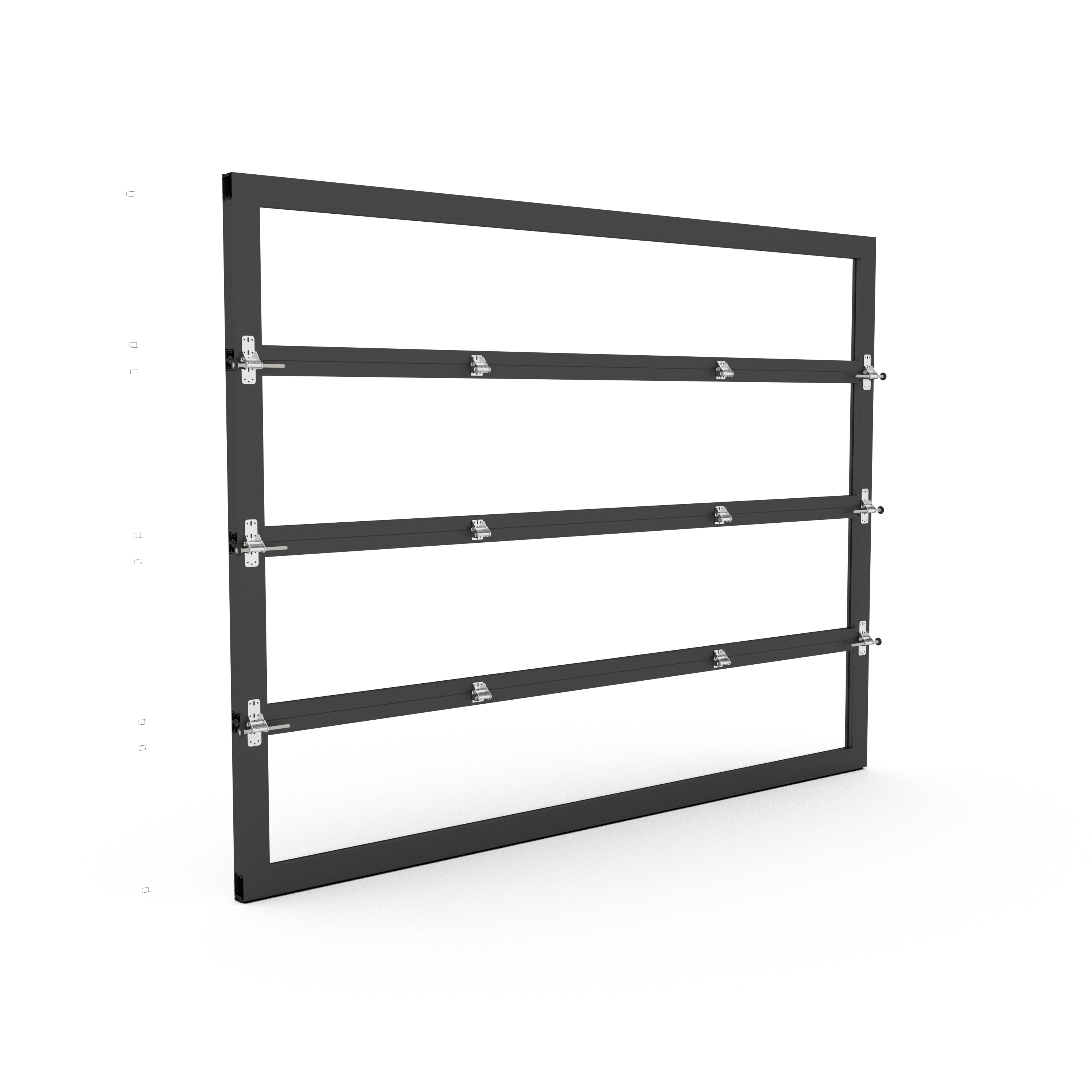
 ES Windows · Prestige Series
ES Windows Prestige ES-PGD3040 Captured-Glass Garage Door
Premium aluminum-and-glass impact garage door with heavy-duty rollers, steel hinges, and motorized operation. For coastal homes where the garage is part of the envelope.
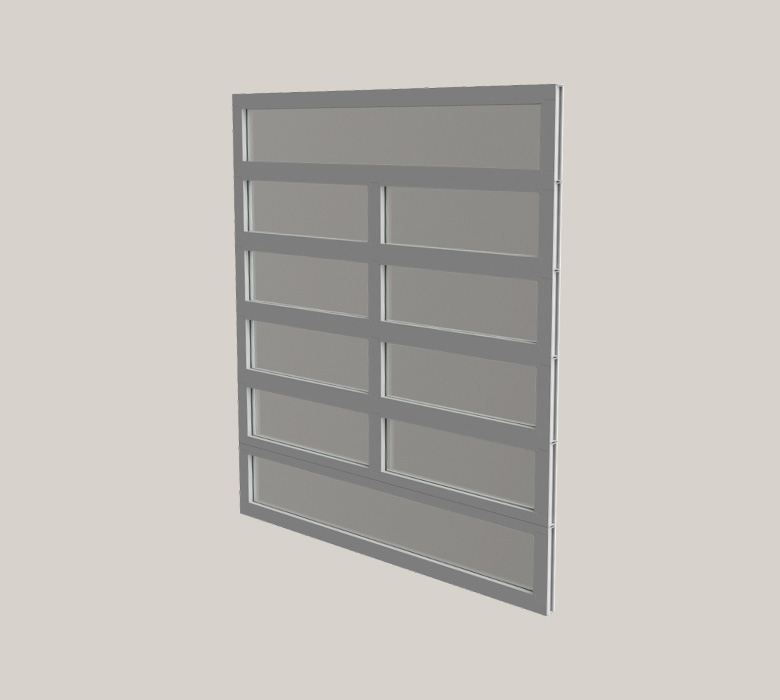
 WinDoor
WinDoor GD9995A Impact Garage Door
Sectional aluminum impact garage door with up to 9 panel sections at unit sizes of 216 by 192 or 192 by 216 inches. LMI for HVHZ envelope coverage.

 ECO · Eco-Guard Garage Door Series
Eco-Guard Garage Door Series 850-16
6-section impact-rated aluminum sectional garage door (page label E870) to 192 x 144 in., +40/-45 psf, LMI.
Next Steps
- Check your address's design wind speed and zone with our wind zone lookup; it takes seconds and anchors every other decision.
- Find and photograph your garage door's rating label, and verify the FL number in the state database.
- If the door has glass inserts, confirm they are impact-rated before your next wind mitigation inspection; that detail alone can decide the credit.
- Read our hurricane garage doors guide for the bracing-versus-replacement decision and current costs.
- Hardening the rest of the envelope? Request a free estimate and we will assess your windows and doors alongside the garage door question, so the whole opening-protection package earns its credit.