
Storm windows for mobile homes are one of the most misunderstood products in Florida hurricane protection. Most of what is sold as an "impact window" for a mobile or manufactured home is not an approved assembly for the wall it would go into. HUD-code homes are built to a federal construction standard, not the Florida Building Code, and impact window approvals are written around site-built walls. For most owners, the honest protection package is a shutter or panel system anchored to the wall framing, a verified tie-down system underneath, and a firm evacuation plan.
We install impact windows and doors in site-built South Florida homes every day, and on this topic our job is often to talk callers out of hiring us. This guide covers why the rules are different, what HUD Wind Zones II and III mean, and why the wall limits what any window can do. It also covers what protection is worth paying for, and the questions that expose a salesperson who does not know this market.
One number frames the stakes. Across the 10.5 million Florida parcel records in the property database we maintain, county property appraisers classify 438,670 parcels as mobile homes under state land-use code 002. That is a lot of housing living under a rulebook most window companies have never read.
Where Florida's Mobile Homes Are
The distribution surprises people: the counties with the most mobile home parcels are not the coastal metros where impact window marketing is loudest, but Central Florida and the Nature Coast.
| County | Mobile home parcels |
|---|---|
| Polk | 31,772 |
| Pasco | 29,477 |
| Marion | 24,534 |
| Pinellas | 17,035 |
| Lake | 16,352 |
| Citrus | 15,783 |
| Putnam | 15,689 |
| Lee | 14,631 |
| Hillsborough | 13,564 |
| Hernando | 12,094 |
Source: our statewide parcel database (10.5M records, county appraiser rolls loaded July 2026), parcels with Florida Department of Revenue use code 002, "Mobile Homes."
In our own service area the counts are smaller but real: Sarasota holds 11,667 mobile home parcels, Broward 4,138, Palm Beach 3,674, Martin 2,932, and Miami-Dade just 303. Those figures undercount the homes themselves, because a home on a rented lot in a park is not a separate parcel; the appraiser rolls the whole park into one commercial record. Park residents face the same protection questions with even less control over the structure.
Two Rulebooks: The HUD Code and the Florida Building Code
Everything unusual about protecting a mobile home starts with who regulates it.
A site-built house in Florida answers to the Florida Building Code, enforced by your local building department, with opening protection required in windborne debris regions. A manufactured home answers to the federal Manufactured Home Construction and Safety Standards, 24 CFR Part 3280, known as the HUD code. Congress created it in 1974, it took effect on June 15, 1976, and it preempts state and local construction codes. Florida law says so directly: the Building Code statute exempts buildings and structures "regulated and preempted by the Federal Government" (s. 553.73(10)(a), F.S.).
Terminology follows the same date line. A "mobile home" is the industry's name for a home built before June 15, 1976, with no federal construction standard behind it; a "manufactured home" is one built after that date to the HUD code. Floridians say "mobile home" for both, and we will too, but the date on the home changes every answer here.
Once the home leaves the factory, Florida picks up a narrow slice of jurisdiction. Installation, anchoring, and tie-downs are state-regulated, and repair or remodeling of the home falls under the state's Mobile/Manufactured Home Repair and Remodeling Code, Rule 15C-2.0081, administered by FLHSMV rather than under the FBC. That rule requires repairs and remodeling to use "material and design equivalent to the original construction," and it names windows and exterior doors. Your county building department still issues the permits, but it reviews mobile home work under different rules than site-built work.
The FBC does apply to one thing on your lot: site-built additions. A framed Florida room, an attached carport, a screen enclosure, or a site-built porch is permitted under the Florida Building Code even when it is attached to a HUD-code home.
HUD Wind Zones II and III: Read Your Data Plate
The HUD code learned its hurricane lesson the same way Florida's site-built code did: from Hurricane Andrew. When Andrew came ashore near Homestead on August 24, 1992, it destroyed 1,167 of the city's 1,176 mobile homes, per the National Hurricane Center's report on the storm. The Dade County Grand Jury reported that 90 percent of all mobile homes in south Dade County were totally destroyed. HUD rewrote its wind standards in response, effective July 13, 1994, creating the wind zone map in use today.
HUD's wind zone rules (24 CFR 3280.305) split the country into three zones, and Florida contains only the two stronger ones:
| Wind Zone II | Wind Zone III | |
|---|---|---|
| Design wind speed | 100 mph (fastest mile) | 110 mph (fastest mile) |
| Florida coverage | All counties not in Zone III | Broward, Charlotte, Collier, Miami-Dade, Franklin, Gulf, Hendry, Lee, Manatee, Martin, Monroe, Palm Beach, Pinellas, Sarasota |
| Window and sliding glass door design pressure | ±38 psf (±48 psf near corners) | ±46 psf (±58 psf near corners) |
Two cautions before you compare those numbers to a site-built spec sheet. The HUD speeds are "fastest mile" figures from an older engineering standard (ASCE 7-88), while the Florida Building Code speaks in 3-second gusts, so 110 mph here and the design speeds our wind zone lookup returns for site-built homes are measured on different scales. And the design pressures apply to the home as an engineered system, from roof trusses to anchoring, not to any one part you could upgrade later.
Every HUD-code home carries a data plate, usually inside a kitchen cabinet, a bedroom closet, or near the electrical panel, stating the wind zone it was built for. Finding it takes five minutes and settles the argument before a salesperson can start it. A pre-1994 home was built to weaker wind requirements than the zone map suggests; a pre-1976 home was built to none.
Why "Impact Windows for Mobile Homes" Is Usually Not a Real Product
Here is the part of the sales conversation that matters most: what an approval actually is.
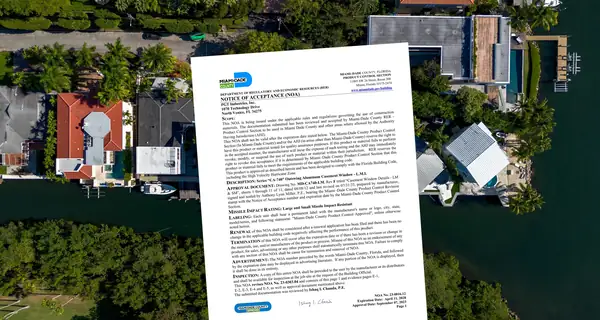
An impact window is not approved as a piece of glass. A Miami-Dade NOA or Florida Product Approval covers an assembly installed a specific way: this frame, this glass makeup, these fasteners at this spacing, embedded this deep into this substrate. The installation drawings that come with every approval name the tested wall, and it is concrete, masonry, or dimensional-lumber bucks. That is the wall the missile test and the pressure cycling were run against, and the approval means nothing outside it.
A mobile home wall is a different animal. The framing is lighter, the sheathing thinner, and the window openings were built for flange-mounted units screwed to the face of the wall through the siding. The load path an impact window needs, where a 9-pound 2x4 strike and thousands of pressure cycles transfer through the frame anchors into structure that can hold them, does not exist in that wall. Screwing a 70-pound laminated glass unit to light framing does not create it. The glass may be genuinely impact-rated; the installed assembly is not, because no approval covers it.
The federal standard is consistent with this. HUD requires manufactured home windows to meet AAMA 1701.2, the manufactured housing window standard, pressure-tested to the design loads in the table above (24 CFR 3280.403). Nowhere does the HUD code require windborne debris impact resistance for glazing, in any wind zone. What it says instead is telling: for homes built for Zones II and III, manufacturers must design the exterior walls around egress windows to allow the installation of shutters or plywood covers (24 CFR 3280.404(f)). The federal code's own answer to flying debris is a cover over the opening, not a stronger window asking the wall to hold it.
So when a company quotes "impact windows" for your manufactured home, one of three things is true. They are selling AAMA-rated replacement windows with laminated glass: real products with real value against pressure, water, and break-ins, but not approved impact protection. They are selling standard replacement windows and borrowing the word. Or they intend to install a site-built window assembly outside its approval, which no honest installer will do. Ask which one it is, and ask for the approval document with its installation drawings.
What Actually Protects a Mobile Home
Real protection for a mobile home is a package, and glass is the least of it. This is the order we would spend money in.
1. Anchoring and tie-downs. In every post-storm study, the homes that survive are the ones that stayed put and connected. Have the tie-down straps and ground anchors inspected: straps tight and straight, anchors free of corrosion, count and spacing matching your county's requirements. FEMA's manufactured home guidance (P-85) covers what a proper anchoring system looks like. Florida's Hurricane Loss Mitigation Program has funded tie-down retrofits for eligible mobile homes for years. A retrofit here buys more survival per dollar than any window ever will.
2. Opening protection that respects the wall. Shutters and panels work on mobile homes because they distribute load across the wall face and anchor into framing members, exactly what the HUD standard anticipates. From our hurricane shutter cost guide, steel storm panels run $7-$12 per square foot installed and fabric panel systems $10-$15; both store flat and suit smaller mobile home openings. Accordion shutters at $15-$30 per square foot are the convenience choice where the wall framing can take the track fasteners. Installers price them by the opening with minimums around $300, and mobile home openings are small, so the minimums set the floor. Whatever you choose, the installer must anchor into framing, not siding, and should say so in writing.
3. The roof and the attachments. Carports, awnings, and skirting fail before walls do, and a failed attachment becomes the debris that breaks a neighbor's opening. Strapping or removing aging awnings before a storm costs almost nothing.
4. A plan to leave. This is the one no product replaces. The State of Florida's guidance is unambiguous: it is never safe to remain in a mobile home during a hurricane or any high-wind event, in any wind zone, with any protection installed. Opening protection gives you a home to come back to; it does not make the home a shelter. Know your evacuation zone, and treat every hurricane warning as a moving day.
When Impact Windows Do Make Sense
We are a window company telling you not to buy windows, so let us be precise about the exceptions.
Site-built additions. That framed Florida room or enclosed porch attached to your home is FBC territory, permitted like site-built construction. If its walls are conventionally framed or block, impact windows and doors with the right approvals can go there, and on many older mobile homes the addition holds the largest glass in the structure. We take this work on, evaluated opening by opening against the approval documents.
Replacement windows chosen for the other 51 weeks. AAMA-rated manufactured housing replacement windows, some with laminated glass options, are legitimate products for energy performance, water resistance, sound, and security. Bought for those reasons at prices that reflect what they are, and paired with panels or shutters for storms, they make sense. Bought as hurricane protection at impact window prices, they are the most expensive storm panels you will ever own. Our impact windows vs. hurricane shutters comparison walks through the same trade-offs for site-built homes.
Replacing the home. For a pre-1976 home, and for many early-1980s units, the structure predates any meaningful wind standard, and there is a point where protection money is better aimed at a newer home. A post-1994 Zone III manufactured home on a proper anchoring system is a different class of structure than what it replaces. We would rather say that plainly than sell shutters to a wall from 1972. And for the callers who also own a site-built house, that is the building where impact glazing earns its cost.
What to Ask Before You Sign Anything
Five questions separate contractors who know this market from those who do not.
- "What wind zone is my home, and where is my data plate?" Anyone quoting storm protection for a manufactured home should ask to see the data plate before pricing anything. If they never mention it, they have not read the rulebook the home was built under.
- "Show me the product approval and its installation drawings." For any window: which substrate is listed, and is your wall in it? For shutters and panels: which fastener schedule applies to your framing?
- "What code and permit does this work fall under?" The right answer names the county permit counter and, for work on the home itself, the state repair and remodeling rules (15C-2.0081), not just "we handle the permit."
- "What are you anchoring into?" Framing members, with sizes and spacing in the proposal. "The wall" is not an answer.
- "When was my tie-down system last inspected?" A contractor selling opening protection while ignoring the anchoring under the home is selling you a locked door on an unmoored boat.
Next Steps
- Find your data plate and note the wind zone and date of manufacture.
- Have your tie-downs and anchors inspected, and check whether the state's Hurricane Loss Mitigation Program is taking applications in your county.
- Price storm panels or accordions for your openings with our shutter cost guide, and insist on anchoring into framing.
- Know your evacuation zone before the season peaks, not during a warning.
- If your property includes a site-built addition or a site-built home, request a free estimate and we will tell you which openings impact products can honestly serve.