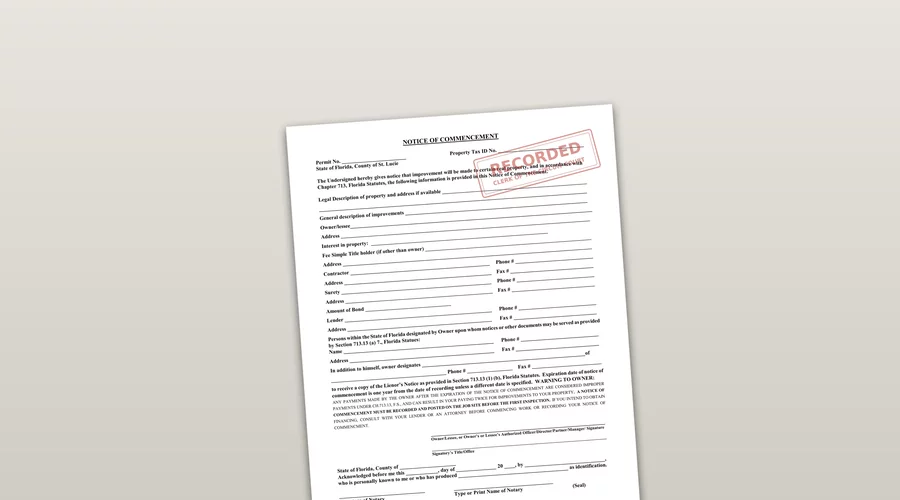

A notice of commencement in Florida is a one-page instrument, created by section 713.13 of the Florida Statutes, that the property owner records with the county before construction begins. It puts the project on the public record for the state's construction lien law: it names the owner, the contractor, and the property, sets the priority date for liens, and tells subcontractors where to send their notices. On any direct contract over $5,000, the building department must have proof of the recorded notice before it can approve your first inspection.
Whole-home impact window and door contracts clear that threshold on nearly every job. The paperwork takes under an hour: fill out the county form, sign before a notary, record for $10, buy a certified copy for $3, and post the copy before the inspector arrives.
This guide covers each step for Miami-Dade, Broward, and Palm Beach counties, checked against the statute text and each county's recording office as of August 25, 2026. It is general information, not legal advice; for a payment dispute or a lien, talk to a construction attorney.
The Five Steps: Record, Certify, Post
| Step | What you do | Cost |
|---|---|---|
| 1. Complete the form | Use your county's form. You need the legal description and folio number (both on your tax bill), the contractor's name and address, and a description of the work. | Free |
| 2. Sign before a notary | The owner signs. Florida law does not let anyone else, your contractor included, sign in your place. | Notary fees vary |
| 3. Record it | File with the recording office in the county where the property sits: in person, by mail, or by eRecording. | $10 for one page |
| 4. Get a certified copy | Order it in the same transaction. A plain photocopy does not satisfy the posting rule. | $3 |
| 5. Post it at the job site | The certified copy (or a notarized statement of filing, with a copy) goes up before the first inspection. | Free |
The dollar figures hold across the tri-county area: we checked the Miami-Dade and Palm Beach fee pages on August 25, 2026, and the amounts are set statewide by s. 28.24(13), Florida Statutes. A one-page notice with one certified copy runs $13 in all three counties.
What a Notice of Commencement Does
Florida's construction lien law gives everyone who improves your property, from the contractor down to the glass supplier, a path to a claim against the property itself if they go unpaid. The notice of commencement organizes that system for your job: it gives constructive notice that lien claims may attach with priority from the recording date, and it names who receives subcontractor notices.
The notice itself is not a lien; s. 713.13(3) says recording it places no lien, cloud, or encumbrance on the property. It is the paper trail that protects you when you pay. The statutory form's warning is blunt: payments made after the notice expires are improper payments "and can result in your paying twice for improvements to your property."
The $5,000 Rule (and the $15,000 HVAC Carve-Out)
The operative number sits in section 713.135, the statute that ties the lien law to your building permit. Before the first inspection, the issuing authority must have a copy of the notice on file "if the direct contract is greater than $5,000." Until it arrives, no inspection can be performed or approved. The $5,000 figure comes from a 2023 revision (ch. 2023-226, Laws of Florida) that raised the old $2,500 threshold; guides still quoting $2,500 are out of date.
One carve-out: the subsection does not apply to a contract to repair or replace an existing heating or air-conditioning system under $15,000. Miami-Dade prints both numbers on its owner information sheet; the carve-out covers AC changeouts, not window work.
Two boundary details:
- The permit itself does not wait. A county cannot demand a recorded notice before issuing the permit; the checkpoint is the first inspection. An approved permit with no notice recorded yet is normal. Permit fees are a separate subject, covered in our breakdown of impact window permit costs across Florida.
- Smaller jobs are not fully exempt. The lien statute's own exemption, s. 713.02(5), only covers contracts of $2,500 or less, so a $4,000 single-opening job still calls for a recorded notice even though no inspector will check.
Who Records It: Owner, Contractor, or Lender
Signing and recording are two different acts. Signing belongs to the owner alone: s. 713.13(1)(g) says the owner must sign the notice "and no one else may be permitted to sign in his or her stead."
Recording is more flexible: the owner or an authorized agent may record, so your contractor can carry the signed original to the county. On our installs, the notice travels with the permit package, and the recorded, certified copy comes back to the job folder before the first inspection. Leaving lien paperwork unassigned, with each side assuming the other filed it, is a cousin of the five mistakes we keep seeing on Palm Beach installs.
One special case: when a construction loan funds the project, s. 713.13(7) puts the recording duty on the lender before any funds are disbursed. Most window and door financing is not draw-based, so on a typical retrofit the duty stays with you and your contractor.
On signing day, bring photo ID for the notary: the form carries an acknowledgment block plus an under-penalty-of-perjury verification (s. 92.525). Two fields cause most rejections: the property description, which needs the full legal description and folio number rather than a street address alone, and item 9, the expiration date, which defaults to one year when left blank.
Where to Record in Miami-Dade, Broward, and Palm Beach
Record in the county where the property sits. The office that does the recording differs by county.
Miami-Dade County. Recording runs through the County Recorder section of the Clerk of the Court and Comptroller: in person or by mail at 20 NW 1st Avenue, Suite 5.246, Miami, FL 33128, or through approved eRecording vendors. eRecording can take one to three business days, so go in person when installation is close. The county serves its form and "Construction Lien Law for Owners" sheet as one packet.
Broward County. Broward is the outlier: official records live with the county's Records, Taxes and Treasury Division, not the Clerk of Courts. The Recording Office is Room 114 of the Governmental Center, 115 S. Andrews Ave., Fort Lauderdale. A website redesign retired Broward's dedicated notice of commencement page; the division's main page is the live starting point.
Palm Beach County. The Clerk of the Circuit Court & Comptroller's Recording Department posts the form, the termination form, and every submission route on one page. eRecorded notices are normally processed within one business day, with electronically certified copies available online. The Main Courthouse and the four branches record in person, a Wednesday window operates inside Planning, Zoning & Building at 2300 N Jog Road, and mail goes to PO Box 4177, West Palm Beach, FL 33402-4177.
| County | Recording office | One-page recording fee | Certified copy |
|---|---|---|---|
| Miami-Dade | Clerk of the Court and Comptroller, County Recorder | $10 | $1 per page + $2 |
| Broward | Records, Taxes and Treasury Division, Recording Office | $10 | $1 per page + $2 |
| Palm Beach | Clerk of the Circuit Court & Comptroller, Recording Department | $10 | $1 per page + $2 |
Miami-Dade and Palm Beach figures are from each clerk's fee page as of August 25, 2026; Broward publishes no fee page, and its charges follow the same statewide schedule in s. 28.24(13).
The Certified Copy and Your First Inspection
The posting requirement is where homeowners most often get caught. Section 713.13(1)(a) requires a certified copy of the recorded notice, or a notarized statement that it has been filed along with a copy, posted at the improvement site. Section 713.135 adds teeth: without proof on file, the building department and any private provider "may not perform or approve subsequent inspections." Miami-Dade's owner sheet says it plainly: no certified copy for the inspector, no passed inspection.
The statute also accepts the clerk's recording information, including the instrument number, which helps when the certified copy is still in the mail. Post the copy next to the permit card. A disapproved first inspection means a re-inspection and days of schedule slip, a cost we cataloged in the hidden costs of impact window installation.
Expiration, the 90-Day Rule, and Ending a Notice Early
Three clocks run on every notice of commencement:
- 90 days to start. If the improvement has not actually commenced within 90 days after recording, the notice is void (s. 713.13(2)). Record close to your start date; a stalled project needs a new notice.
- One year of effect. Unless item 9 states a different date, the notice stops being effective one year after recording. Payments made after that are improper payments, the pay-twice trap.
- 30 days to terminate. When a sale or refinance cannot wait out the year, s. 713.132 lets the owner record a notice of termination: effective no sooner than 30 days after recording, sworn statement that all lienors are paid, copies served on the contractor and every lienor who sent a notice.
An open notice is not a lien, but title searches surface it until it expires or is terminated. For a routine window job that ends on schedule, letting the year run out is the normal path.
Next Steps
If you are planning an impact window or door project in the tri-county area, the notice of commencement is a $13 errand we can walk you through in one conversation alongside the permit and inspection sequence. Request a free estimate and we will map the paperwork path for your address before any contract is signed.