



The Quick Answer
Hurricane shutters cost $7 to $40 per square foot installed in Florida for most systems, from steel storm panels at the bottom of the range to manual roll-downs near the top. Premium motorized and smart roll-down systems run past that, averaging $50-$70 per square foot. For a typical 3-bedroom, 2-bathroom home with 12-15 openings:
- Storm panels: $2,000-$7,000
- Accordion shutters: $5,000-$12,000
- Roll-down shutters (manual): $8,000-$15,000
- Roll-down shutters (motorized): $12,500-$25,000
These are fully installed prices including hardware, tracks, mounting brackets, and labor. Permits ($50-$300 depending on jurisdiction) are typically additional.
The rest of this guide breaks down pricing by shutter type, explains what drives cost variation, and shows how to reduce your out-of-pocket through insurance savings, grants, and smart product mixing.
Cost by Shutter Type
| Shutter Type | Cost/Sq Ft | Per Window (3x5 ft) | Per Sliding Door (8 ft) | Whole Home (12-15 openings) | Deployment Time |
|---|---|---|---|---|---|
| Steel storm panels | $7-$12 | $150-$300 | $300-$600 | $2,000-$5,000 | 3-6 hours (2 people) |
| Aluminum storm panels | $10-$20 | $200-$400 | $400-$800 | $3,500-$9,000 | 3-6 hours (2 people) |
| Clear polycarbonate panels | $10-$30 | $250-$500 | $500-$1,000 | $4,000-$8,000 | 3-6 hours (2 people) |
| Accordion shutters | $15-$30 | $300-$700 | $600-$1,500 | $5,000-$12,000 | 15-30 minutes |
| Bahama shutters | $20-$35 | $400-$800 | N/A (windows only) | $9,000-$15,000 | 15-30 minutes |
| Colonial shutters | $20-$50 | $400-$800 | N/A (windows only) | $10,000-$16,000 | 20-40 minutes |
| Roll-down (manual crank) | $25-$55 | $500-$1,000 | $800-$2,000 | $8,000-$15,000 | 5-15 minutes |
| Roll-down (motorized) | $35-$70+ | $700-$1,500 | $1,200-$3,000 | $12,500-$25,000 | Under 5 minutes |
| Fabric panels/screen systems | $10-$15 | $150-$400 | $400-$900 | $1,500-$4,000 | 1-3 hours |
Storm Panels: The Budget Option
Storm panels are flat sheets of steel, aluminum, or clear polycarbonate that bolt into pre-installed tracks above and beside each window. They're stored in the garage between storms and installed manually before each hurricane.
Best for: Budget-conscious homeowners, rental properties, secondary openings where cost matters most.
The trade-off: Deployment takes 3-6 hours with two people, requires a ladder for upper-floor windows, and is physically demanding. If you're elderly, traveling during storm season, or unable to recruit help, panels may not get installed when you need them. Each panel is also numbered for a specific opening, so a disorganized garage stack turns a 3-hour job into a much longer one.
Steel vs. aluminum vs. polycarbonate: Steel is cheapest but heaviest and rusts in salt air (requiring annual rust treatment). Aluminum is lighter and corrosion-resistant but costs 30-50% more. Polycarbonate (Lexan-type) is clear, letting light through and allowing you to see outside during the storm, but costs the most and scratches more easily.
Accordion Hurricane Shutters Cost: The Most Popular Permanent Option
Accordion shutters mount permanently on either side of each window or door opening on tracks along the top and bottom. To deploy, you pull them closed from both sides and lock them in the center. No tools, no ladder, no storage. Accordion hurricane shutters cost $15-$25 per square foot installed on most standard openings, with HVHZ-certified systems on oversized spans reaching $30.
Accordion Shutter Prices by Window Size
Installers price accordions by the opening, and most carry an effective per-opening minimum of around $300, so small windows don't scale down linearly. Typical installed prices by common Florida window sizes:
| Opening | Approximate Area | Installed Price |
|---|---|---|
| Small bath window (26" x 38") | 7 sq ft | $300-$400 (minimum applies) |
| Single-hung window (37" x 50") | 13 sq ft | $300-$450 |
| Horizontal roller (52" x 62") | 22 sq ft | $350-$550 |
| Twin or picture window (72" x 62") | 31 sq ft | $475-$775 |
| 6-ft sliding glass door (72" x 80") | 40 sq ft | $600-$1,000 |
| 8-ft sliding glass door (96" x 80") | 53 sq ft | $800-$1,350 |
For a rough self-calculation: multiply each opening's width by its height in feet, multiply the result by $15-$25, and apply a $300 floor per opening. Add them up and you have a sanity check for any quote.
What Drives Accordion Shutter Installation Cost
- Track length. You pay for extrusion: top and bottom track spanning the opening's width, plus blades covering its full height. Wide, tall openings cost more in near-linear fashion, and bi-parting configurations (panels closing from both sides, workable on spans up to about 24 feet) add hardware at the center meeting point.
- No motor. Accordions are manual. You pull the panels closed and lock them, so there is no motor, no wiring, and no electrical permit in the bill. That is the main reason a whole home in accordions costs roughly half of the same home in motorized roll-downs.
- Locking hardware. A thumb-turn center-mate lock is standard. Keyed cylinders (lockable from outside) and storm bars that reinforce large spans add cost per opening.
- Blade gauge and design pressure. Higher design-pressure ratings and larger spans call for the heavier 0.062-inch blade instead of the standard 0.050-inch, which raises material cost.
- HVHZ certification. Miami-Dade and Broward require NOA-certified product, which carries a 15-30% premium over equivalent non-HVHZ systems.
- Second-story access. Upper-floor openings add $50-$200 each for ladder or scaffold work.
A Worked Whole-Home Accordion Example
Take a 3/2 concrete-block home with 12 openings. Eight standard windows (13-22 sq ft) at $300-$550 each come to $2,400-$4,400. Three oversized windows at $475-$775 each add $1,425-$2,325. One 8-ft sliding glass door runs $800-$1,350, and the permit $50-$300. Total: roughly $4,700-$8,400 installed. Larger homes with 18-22 openings, several sliders, and HVHZ certification climb to $7,500-$12,500, which is how the whole-home range stretches past $12,000.
Best for: Most Florida homeowners who want permanent protection with reasonable cost and easy deployment. The accordion lines you'll see most often on South Florida quotes, such as Eastern Metal Supply's Bertha HV and AMD's SuperNova, are HVHZ-approved and rated for design pressures from 40 to as high as 160 PSF.
The trade-off: The tracks and housing are visible on the exterior of your home at all times, which affects curb appeal. When retracted, accordion shutters stack as folded panels beside the window. On large openings (sliding glass doors, lanais), the stacked panels can be substantial. Accordion blades also don't form a watertight seal, so some water intrusion during long rain events is normal, though in FIU Wall of Wind testing accordion systems still reduced wind-driven rain intrusion by 77-87%.
For sliding glass doors: Accordion shutters are particularly cost-effective for large sliding glass door openings where impact-rated sliding glass doors can cost $3,500-$9,000+. An accordion shutter over a standard (non-impact) sliding glass door costs $600-$1,500 and provides code-compliant opening protection.
Bahama and Colonial Shutters: The Decorative Options
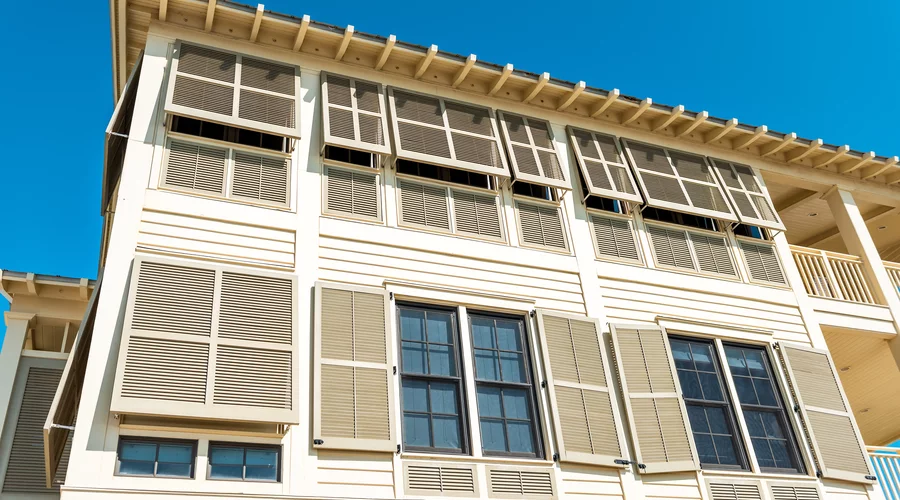
Bahama shutters mount above the window on a hinge and prop open at an angle, providing shade and rain protection even when not deployed for storms. To deploy, you lower them flat against the window and secure them. They work only on windows, not doors.
Colonial shutters mount in pairs on either side of the window, like traditional exterior shutters. They fold outward in normal conditions and close flat over the window for storms. Also windows only.
Best for: Homeowners who want storm protection that enhances rather than detracts from curb appeal. Popular on Mediterranean, coastal, and traditional-style homes.
The trade-off: Limited to windows. Cannot be used on sliding glass doors, entry doors, or garage openings. Bahama shutters partially obstruct the view even in their open position. Both cost as much as roll-down shutters per square foot but offer less protection per dollar (single-layer construction vs. the multi-slat design of roll-downs).
Roll-Down Hurricane Shutters Cost: The Premium Choice
Roll-down shutters mount in a housing above the window or door. To deploy, you either turn a manual crank or press a button (motorized models). The shutter rolls down from the housing, covering the opening. When retracted, it's hidden inside the housing and nearly invisible from the street.
So how much do roll-down hurricane shutters cost? Manual crank models run $500-$1,000 per standard window installed ($25-$55 per square foot). Motorized models run $700-$1,500 per window and $1,200-$3,000 per sliding glass door, averaging $50-$70 per square foot, and premium smart systems with integrated automation, wind sensors, and battery backup can reach $100 per square foot. Whole home: $8,000-$15,000 manual, $12,500-$25,000 motorized.
Three cost drivers separate roll-downs from cheaper shutter types. The motor and automation package can account for 30-50% of the total installed cost. Motorized units need wiring by a licensed electrician, often under a separate electrical permit. And the housing box must anchor to the structural header above the opening, not just the wall finish. Budget for the motor's service life too: replacement motors cost $300-$800, typically at year 10-15.
Best for: Homeowners who want the fastest deployment, cleanest aesthetics, and are willing to pay for convenience. Motorized roll-downs are the premium option for snowbirds and second-home owners who may not be present during storms.
The trade-off: Highest cost per opening. Motorized models require electrical wiring (additional installation cost) and can fail during power outages without a manual override or battery backup. The motor and track mechanisms are more complex than other shutter types, creating more potential maintenance needs, particularly in salt-air environments where tracks can corrode and motors can fail.
Fabric and Screen Systems
Fabric shutters (like Storm Catcher screens) use high-strength synthetic fabric or perforated metal mesh that deploys from a top housing or mounts with clips. Some meet Florida Building Code requirements; verify product approval for your specific zone.
Best for: Large openings (lanais, pool enclosures) where rigid shutters are impractical or prohibitively expensive.
The trade-off: Limited lifespan compared to metal shutters (5-10 years vs. 15-30 years). Not all fabric systems meet FBC impact requirements. Verify the Florida Product Approval number before purchasing. Professionally installed fabric panels run $10-$15 per square foot; DIY kits sell for about $5.50-$6.60 per square foot.
Factors That Drive Your Cost Up or Down
1. Number and size of openings. The single biggest factor. More openings = higher total cost. Larger openings (sliding glass doors, picture windows) cost more per unit than standard windows.
2. Story height. Upper-floor installations add $50-$200 per opening for scaffolding and additional labor. This is especially significant for storm panels, which require ladder access for every deployment.
3. Wall construction. Installing into concrete block (CBS) requires different anchors than wood frame or stucco-over-frame, affecting labor time and hardware cost.
4. Motorization. Adding motors to roll-down shutters adds $200-$500 per opening for the motor, wiring, and controls. A central control system (all shutters on one switch) adds $500-$1,500 for the controller.
5. Material grade. Heavier aluminum gauge, stainless steel hardware, and marine-grade finishes cost more but last longer in coastal salt-air environments. Standard hardware may need replacement after 10-15 years near the coast. Tariffs are adding pressure here too: Section 232 duties on aluminum rose to 50% in mid-2025 and were extended to finished aluminum window and door products in April 2026, and nearly every permanent shutter type is extruded aluminum.
6. Permits and inspection. $50-$300 depending on municipality. Permanently mounted shutters (accordion, roll-down, Bahama, colonial) require permits, and most jurisdictions treat the track systems for removable storm panels as permitted work as well. A post-installation inspection verifies the anchoring matches the product approval.
7. Region. South Florida (HVHZ) requires products with Miami-Dade NOA certification, which costs more. Southwest Florida (post-Ian) and Tampa Bay (post-Milton) have elevated demand and labor costs. Central and North Florida are generally less expensive.
Hurricane Shutters vs. Impact Windows: The Cost Question
This is the comparison most Florida homeowners are weighing. Here's how the numbers stack up for a typical 3/2 home with 12-15 openings:
| Factor | Accordion Shutters | Impact Windows |
|---|---|---|
| Upfront cost | $5,000-$12,000 | $25,000-$40,000 |
| Annual maintenance | $100-$300 | $0-$100 |
| Insurance savings | 30-45% of wind premium (identical credit) | 30-45% of wind premium (identical credit) |
| Energy savings | $0/year | $500-$800/year |
| Property value increase | Minimal | 7-10% of home value |
| Deployment required | Yes (15-30 min) | No (always on) |
| Noise reduction | None (when open) | STC 32-40 |
| UV protection | None (when open) | 99% UV blocking |
| Security | When deployed only | 24/7 forced-entry resistance |
| Lifespan | 15-25 years | 25-30 years |
Shutters cost 50-70% less upfront, and the insurance math doesn't break the tie: Florida's wind mitigation form applies identical opening-protection credits to certified shutters and impact glass, so a $10,000 accordion job earns the same discount as a $35,000 window package once every opening is protected. What shutters don't generate is the $500-$800/year in energy savings and the 7-10% property value increase that impact windows add. Over 20 years, impact windows frequently pay their cost back while shutters remain a pure cost.
 PGT · WinGuard Aluminum Series
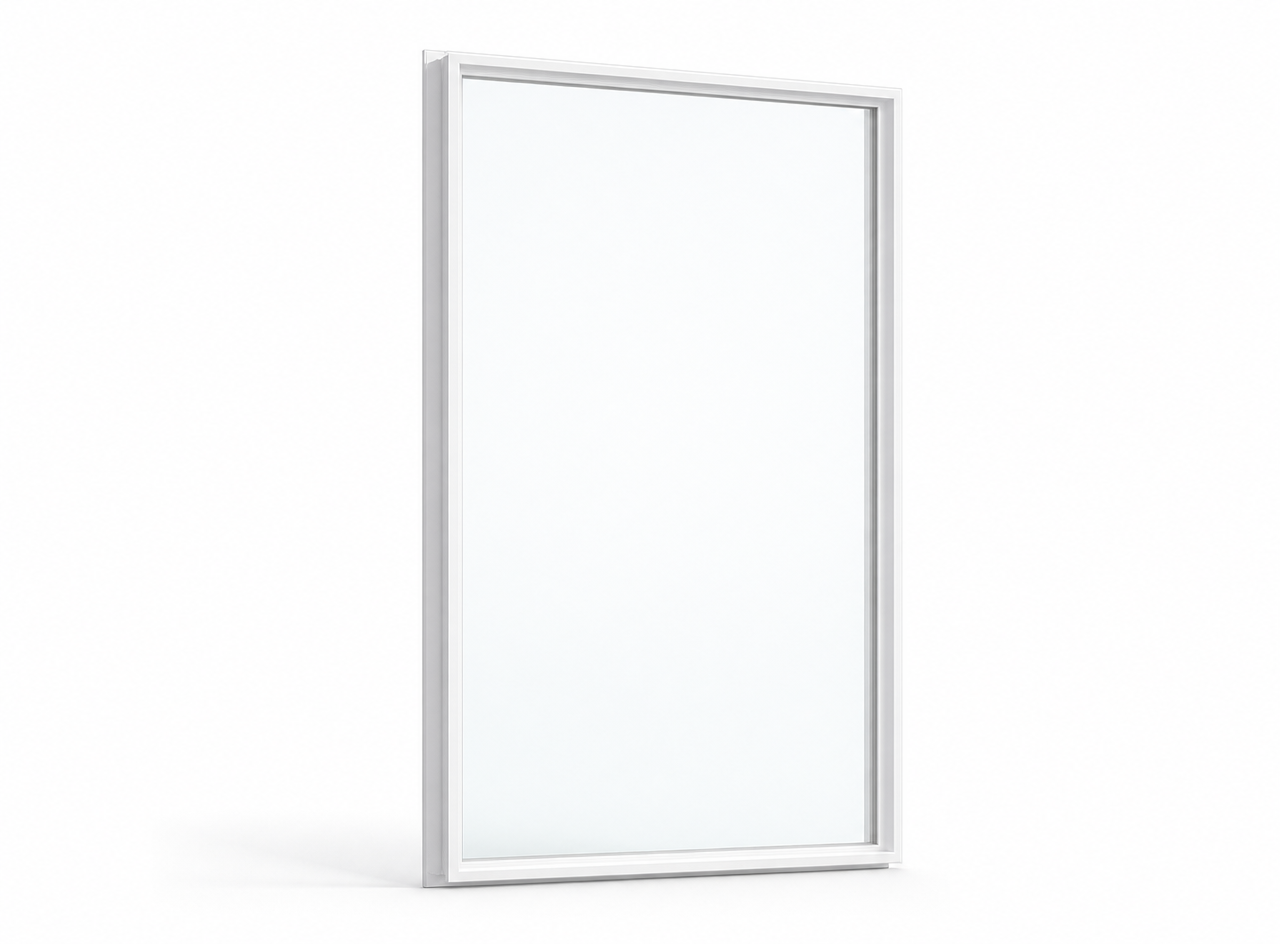
PGT WinGuard Aluminum Picture PW7720A
Aluminum impact fixed picture window on the WinGuard 7720 picture platform for unobstructed view installations. Diamond Glass, LMI for HVHZ.
 ECO · Eco-Guard Architectural Fixed Window Series
Eco-Guard Architectural Fixed Window Series 70
Entry aluminum impact fixed window, 2-1/8 in. frame, +60/-60 psf, LMI, up to 32 x 104 in.
 ES Windows · Multimax Series
ES Windows Multimax ES-MX1500 Fixed Window
Value-tier aluminum impact fixed window up to 36 by 120 inches on a 2-3/8 inch frame. Dual LMI+SMI at 100 psf positive, 140 psf negative for low-rise and high-rise HVHZ.
For a deep dive on this comparison with 20-year total cost of ownership calculations, see our Impact Windows vs. Hurricane Shutters guide.
The Hybrid Approach
Many homeowners combine both, capturing the best value from each:
- Impact windows on bedrooms, living areas, and upper floors (daily comfort + hard-to-access areas)
- Accordion shutters on large sliding glass doors and lanais (cost-effective for oversized spans)
- Impact doors on all entry points
This approach can reduce total cost by 20-30% compared to full impact glazing while still qualifying for the opening-protection insurance credit, which is all-or-nothing: every opening must be covered by some certified product, but mixing product types is fine.
Regional Price Differences
| Region | Price Level | Why |
|---|---|---|
| Miami-Dade / Broward (HVHZ) | Highest | Products must carry Miami-Dade NOA; highest labor costs |
| Palm Beach | High | Premium market; elevated labor costs |
| Southwest FL (Lee, Collier) | Moderate-High | Post-Ian demand elevated prices |
| Tampa Bay (Pinellas, Hillsborough) | Moderate | Post-Milton demand increase |
| Central FL (Orange, Seminole) | Moderate-Low | Lower wind requirements, lower labor costs |
| North FL (Duval) | Lowest | Least stringent requirements |
Ways to Reduce Your Cost
My Safe Florida Home Program
Hurricane shutters are an eligible improvement under the MSFH program:
- Low-income homeowners: grants up to $10,000 with no matching required
- Moderate-income homeowners: a $2-for-$1 state match up to $10,000 (you spend $5,000, the state adds $10,000, funding a $15,000 project at full match)
- Apply at mysafeflhome.com
PACE Financing
$0 down, with repayment through your property tax bill over 10-25 years at rates typically between 6% and 9%. Approval is based on home equity and verified income rather than your credit score alone; under federal rules in effect since March 2026, PACE lenders must confirm your ability to repay. Know what you're agreeing to before signing: PACE places a lien on the property, which can complicate a refinance or sale.
Mix and Match
You don't have to use the same shutter type on every opening. A cost-effective strategy:
- Roll-down shutters on the most visible openings (front windows, main entry) for aesthetics and convenience
- Accordion shutters on side and rear windows (permanent, easy to deploy, moderate cost)
- Storm panels on small secondary windows (bathrooms, laundry) where deployment frequency is low and aesthetics are less important
This mixed approach can save 20-40% compared to using roll-downs everywhere while maintaining code compliance and full insurance credit eligibility.
Off-Season Installation
Shutter demand peaks from May through September (hurricane season awareness). Scheduling installation in November through March often means faster availability, more scheduling flexibility, and occasionally promotional pricing from installers.
Additional Financing Options
Most installers offer $0 down and 100% financing options beyond PACE. Combined with insurance savings, the effective monthly cost of hurricane shutters can be very manageable.
Maintenance and Lifespan
| Shutter Type | Expected Lifespan | Maintenance Needs |
|---|---|---|
| Steel panels | 10-15 years | Annual rust treatment; rinse after salt exposure |
| Aluminum panels | 15-25 years | Minimal; rinse after salt exposure |
| Accordion | 20-30 years | Track lubrication every 3-6 months; inspect locks and rollers |
| Bahama/Colonial | 20-30 years | Annual hinge inspection; refinish every 5-7 years |
| Roll-down (manual) | 15-25 years | Regular full up/down cycling; lubricate guide rails; inspect crank mechanism |
| Roll-down (motorized) | 15-20 years (motor: 10-15 years) | Same plus motor service; battery backup check |
| Fabric/screen | 5-10 years | Inspect fabric for tears; clean tracks |
In coastal salt-air environments (within 3 miles of the ocean), metal components corrode faster. Stainless steel hardware and marine-grade finishes extend lifespan significantly but add 10-20% to the initial cost. Budget for this upfront rather than paying for premature replacement later.
Next Steps
- Get a free estimate that includes shutter pricing for every opening on your home, with options across shutter types so you can compare. We provide hurricane shutter installation services — accordion, roll-down, Bahama, colonial, and panel systems — across South Florida.
- Consider the hybrid approach. Ask your installer to quote impact windows on primary living spaces and shutters on secondary openings for the best cost-to-protection ratio.
- Check MSFH eligibility at mysafeflhome.com for grants up to $10,000 toward hurricane shutters and other improvements.
- Don't forget the garage door. One unprotected opening means no opening-protection credit at all. See our hurricane garage doors guide.
- For the full shutters vs. impact windows analysis, see our data-driven comparison with 20-year total cost of ownership calculations.