

Why Your Roof's Most Vulnerable Spot Isn't Where You Think
Most homeowners think of the roof as one surface. When they worry about hurricane damage, they picture shingles blowing off the middle of the roof. But that's not where damage starts.
Damage starts at the edge.
The overhang, the section of roof that extends past your exterior walls and creates the eave, is the roof's weakest point during a hurricane. The soffit panels that enclose the underside of the overhang are typically the first building component to fail. And when they do, they trigger a cascade that can progress from "cosmetic damage" to "total roof loss" over the course of a single storm.
This isn't speculation. The Florida Building Commission funded two consecutive research cycles (2020-2021 and 2021-2022) studying wind-induced loads on roof overhangs. After Hurricane Charley (2004), assessments found that 75% of homes had lost soffit materials. After Hurricanes Helene and Milton (2024), University of Florida researchers documented that roof edge failures and fastener pull-through were the primary damage mechanisms even in homes built to modern code standards.
Understanding why this happens and what you can do about it is essential for any Florida homeowner, whether you're planning a reroof, building a new home, or just trying to protect the investment you've already made in impact windows and impact doors.
The Physics: Why Overhang Pressure Is 2-3x Higher Than the Roof Center
When hurricane-force wind hits a building, the pressure isn't uniform across the roof. Wind accelerates as it flows over the roof edge, creating a zone of intense low pressure (suction) at the eave. At the same time, positive pressure on the windward wall deflects upward and strikes the underside of the soffit, adding an upward push to the downward pull.
The combined effect creates uplift forces at the eave that are 2 to 3 times higher than forces on the center of the roof.
The American Society of Civil Engineers quantifies this through pressure coefficients in ASCE 7-22. For roof overhangs, the coefficient is calculated by adding the roof surface pressure to the wall surface pressure at that point:
| Roof Zone | Pressure Coefficient (GCp) | Relative Intensity |
|---|---|---|
| Zone 1 (center of roof) | -1.0 to -1.3 | Baseline |
| Zone 2 (eave/ridge perimeter) | -1.5 to -2.0 | 1.5-2x center |
| Zone 2e (eave overhang) | -2.5 to -3.0 | 2-3x center |
| Zone 3 (corners) | -2.5 to -3.5 | 2.5-3.5x center |
| Zone 3e (corner overhang) | -3.0 to -4.0+ | 3-4x center |
A negative coefficient means suction (pulling the roof upward). At Zone 3e (corner overhang), the combined coefficient of -3.0 to -4.0 means the upward suction at the corner overhang is three to four times the pressure on the main roof deck. This is why corners are the first place you see damage after a storm.
What FIU's Wall of Wind Found
The FBC Phase I study (2020-2021) tested full-scale roof overhang assemblies at FIU's Wall of Wind facility, the only U.S. university facility capable of generating Category 5 hurricane conditions. The findings were significant:
- Actual overhang pressures exceeded the values assumed in ASCE 7-16 for certain overhang configurations
- The pressure on the soffit (underside) was not simply equal to the adjacent wall pressure, as the code had assumed. It was higher in many configurations.
- Shorter overhangs experienced higher peak pressures per unit area than longer overhangs
- The pressure distribution was highly sensitive to overhang length and roof slope
The Phase II study (2021-2022) refined these findings with additional configurations and correlated them with real hurricane damage patterns, providing the data needed for future code updates.
How Soffits Fail: The Step-by-Step Sequence
Understanding the failure sequence helps you understand why each preventive measure matters.
Step 1: Soffit Panels Vibrate and Detach
Soffit panels are the first building component to fail because they're typically the weakest structural element exposed to the highest relative pressure. Most residential soffits in Florida are either:
- Vinyl panels friction-fit into J-channel or F-channel tracks (the most common)
- Aluminum panels stapled or nailed into F-channel or J-channel
- Continuous aluminum soffit screwed to framing (the strongest option)
The first two are vulnerable. Research from the FBC and post-hurricane assessments has documented the specific failure modes:
- Vinyl in J-channel: Wind oscillation causes panels to walk out of their tracks. Vinyl bows dramatically before detaching, but the J-channel provides minimal mechanical retention. FBC researchers found this is the most common failure mode.
- Aluminum stapled to F-channel: T-nails and staples pull through the thin channel material when loaded by wind. Pneumatic staplers without depth adjustment overdrive fasteners, further reducing pull-through resistance. Aluminum panels flex slightly and then fail completely, unlike vinyl which bows before releasing.
- At building corners: The geometry creates complex corkscrew wind patterns that attack soffit panels from multiple angles simultaneously. Corner soffits fail first, even when mid-wall soffits hold.
Step 2: Rain Enters the Attic
Once soffit panels are gone, the attic is open to the storm. Wind-driven rain penetrates through the exposed soffit opening and saturates the attic insulation, ceiling drywall, and any stored belongings. FBC-funded research found that water intrusion through vented soffits begins at winds as low as 90 mph, even before the soffit panels themselves detach.
Vented soffits (with perforations for attic ventilation) are particularly vulnerable. The ventilation perforations become rain entry points during any storm with wind-driven rain, even without soffit failure. This is a design conflict: the building needs attic ventilation to prevent moisture problems year-round, but the ventilation openings become liabilities during hurricanes.
Step 3: Roof Decking Edges Are Exposed to Uplift from Both Directions
This is where the damage accelerates from "water damage" to "structural failure."
With the soffit gone, the edge of the roof decking (plywood or OSB sheathing) is now exposed to wind from below as well as suction from above. The sheathing must resist:
- External suction from wind flowing over the top of the roof (the normal design condition)
- Internal pressure from wind entering through the open soffit cavity (a condition the sheathing was not designed for)
The combined load can be 2-3x what the roof edge sheathing was designed to resist. The edge fasteners, typically nails driven through the sheathing into the rafter or truss tail, are now loaded far beyond their rated capacity.
Step 4: Edge Sheathing Separates and the Failure Progresses Inward
The nails holding the edge sheathing pull through (the head of the nail tears through the sheathing material) or withdraw from the rafter. The sheathing lifts at the edge, and wind gets under the panel. The failure then progressively peels inward, panel by panel, like opening the page of a book.
University of Florida researchers found that in every observable roof decking failure after Helene and Milton, the mechanism was fastener head pull-through, not nail withdrawal. This distinction matters for prevention: ring-shank nails (which have higher withdrawal resistance) do not necessarily improve pull-through resistance. In fact, the transition from smooth-shank to ring-shank nails increased withdrawal resistance by approximately 50% but slightly decreased pull-through capacity. Overdriven nails (a common pneumatic gun defect where the nail head is driven below the surface of the sheathing) reduce pull-through capacity by approximately 15%.
Step 5: Total Roof Compromise
Once edge failure progresses past the first row of sheathing panels, the roof system is compromised. Wind gets under larger and larger areas of the roof deck, and the uplift forces escalate exponentially. At this point, even a roof with excellent roof-to-wall connections (hurricane straps, clips) can lose its covering because the sheathing is failing, not the structural connections.
The Connection to Your Impact Windows
Here is the detail that makes soffit integrity directly relevant to anyone who has invested in impact windows and impact doors:
A home with perfect impact windows can still suffer massive water damage if the soffit fails.
Impact windows keep the building envelope sealed against wind-borne debris. They prevent the internal pressurization cascade that causes roofs to separate and homes to be destroyed. After Helene and Milton (2024), zero post-FBC homes were destroyed, and impact windows were a major reason why.
But impact windows can't protect your home from water that enters through the attic. If the soffit fails and rain pours into the attic cavity, it saturates insulation, destroys ceilings, damages electrical systems, and creates the conditions for mold growth, all while the impact windows below remain perfectly intact.
The building envelope is a system. Impact windows protect the vertical openings. The roof system (including soffits) protects the top. Both must perform for the home to survive a hurricane without significant damage. Investing $25,000 in impact windows while ignoring deteriorating soffits is like buying a waterproof jacket with no hood.
What Homeowners Can Do
During a Reroof (Best Opportunity)
A reroof is the ideal time to address overhang vulnerability because the sheathing, underlayment, and edge details are all exposed. If you're reroofing, add these items to your scope:
Metal drip edge at all roof edges. Drip edge is a metal strip installed along the eave and rake (the sloping edge of a gable roof) that directs water away from the fascia and into the gutter. It also provides a mechanical connection between the roof edge and the fascia. Code-required in most Florida wind zones. Cost: approximately $3-$6 per linear foot installed.
Enhanced edge nailing. Use ring-shank nails (for withdrawal resistance) at 4-inch spacing along the first 4 feet of roof edge sheathing, rather than the standard 6-inch spacing used in the field of the roof. Better yet, use screws, which have superior pull-through resistance to either nail type. This directly addresses the fastener pull-through mechanism that UF researchers identified as the primary failure mode.
Secondary water barrier (SWR) extending past the roof edge. A peel-and-stick self-adhering membrane applied directly to the roof deck. If shingles or tiles blow off, the SWR prevents water from reaching the interior. Extend it at least 24 inches past the wall line to cover the overhang area. Cost: approximately $500-$2,000 added to a reroof project. Also earns a 5-7% discount on your wind mitigation inspection.
Upgraded soffit panels. Replace individual snap-in vinyl or aluminum panels with continuous aluminum soffit screwed to framing. Continuous soffit has no individual panel edges to catch wind, and screw attachment provides dramatically better retention than friction-fit J-channel or stapled F-channel. Cost: approximately $8-$15 per linear foot installed.
On Existing Homes (Without Reroofing)
You don't have to wait for a reroof to address the most critical vulnerabilities:
Inspect soffit attachment annually. Walk the perimeter of your home and look up. Look for soffit panels that are loose, sagging, separated at the joints, or missing entirely. Check especially at corners, where damage is most likely.
Replace stapled soffit with screwed attachment. If your soffit panels are held in place with staples or friction-fit into J-channel, a contractor can upgrade the attachment to screws without removing the panels (in most cases). This single change dramatically improves wind retention.
Add soffit bracing at corners. Corner soffits experience the highest wind loads. Adding horizontal bracing members between the fascia and the wall plate at corner locations provides structural reinforcement where it matters most.
Clear any debris from soffit vents. Blocked soffit vents cause the attic to pressurize unevenly during wind events, which can increase uplift loads on the roof sheathing.
Check for and seal any gaps between the soffit and the wall. Over time, settling, expansion, and contraction can open gaps where the soffit meets the exterior wall. These gaps become wind and water entry points during a storm. Seal them with exterior-grade caulk.
For New Construction
Consider shorter overhangs in high-wind zones. Shorter overhangs present less surface area for uplift forces to act on. A 12-inch overhang experiences significantly lower total uplift load than a 24-inch overhang, because total force equals pressure times area. The trade-off is less rain protection for the wall below, which can be addressed with deeper gutters.
Specify reinforced soffit systems rated for the design wind speed. Standard residential soffit products are rated for general use, not for the specific wind loads your location requires. In the HVHZ and high-wind coastal zones, specify soffit systems with documented wind resistance ratings matching the required design pressure for your building.
Choose hip roofs over gable roofs. Hip roofs (where all four sides slope) have inherently better overhang performance because they distribute wind pressure more evenly across the entire perimeter. Gable roofs concentrate wind forces on the flat gable end walls, which creates both a wall failure risk and higher overhang pressures at the gable rake. A hip roof earns a 28-32% wind premium discount on the wind mitigation form.
Use continuous ridge ventilation instead of soffit vents. Continuous ridge vents at the roof peak provide attic ventilation without creating wind-driven rain entry points at the eave. This eliminates the design conflict between ventilation and hurricane performance. Some Florida jurisdictions are already requiring this in high-wind zones.
The IBHS FORTIFIED Standard
The Insurance Institute for Business & Home Safety (IBHS) developed the FORTIFIED program specifically to address the weak points that standard code doesn't fully protect, including roof edges and soffits. FORTIFIED certification requires:
- Sealed roof deck (continuous underlayment with sealed seams)
- Drip edge at all edges (thicker gauge than code minimum)
- Starter shingles fully adhered to the roof deck
- Enhanced hip and ridge capping
- Sealed soffit joints
Homes with FORTIFIED certification have demonstrated significantly better performance in hurricanes, and some insurance companies offer premium discounts for FORTIFIED homes beyond the standard wind mitigation credits. If you're reroofing anyway, the incremental cost of meeting FORTIFIED standards is modest compared to the protection and insurance benefits.
What Post-Hurricane Assessments Tell Us
Hurricane Charley (2004)
After Charley struck Southwest Florida as a Category 4 storm and tracked across the state, assessments found that 75% of surveyed homes had lost soffit materials. This was the single most common damage type, ahead of roof covering loss, window failure, or structural damage. The soffit damage triggered secondary water damage in the majority of those homes.
Hurricanes Helene and Milton (2024)
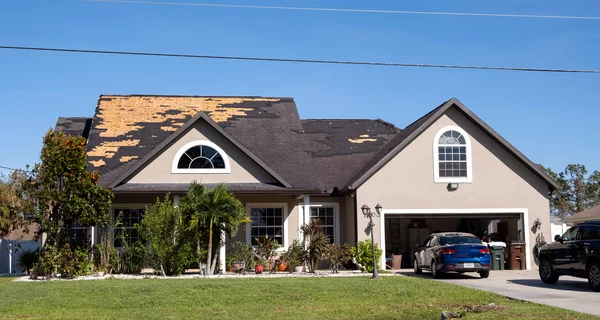
UF researchers assessed 358 structures and found that roof edge failure was a consistent damage pattern even in post-FBC homes that survived structurally. In the Stuart, Florida tornado path from Milton, a 1977 home retrofitted in 2017 with impact windows and in 2020 with a metal roof still lost approximately 40% of its roof from fastener pull-through. The impact windows performed their function perfectly. The roof failed above them from a separate deficiency in edge sheathing attachment.
This case illustrates the core message: impact windows are necessary but not sufficient. The roof edge is a separate system that requires separate attention.
The Fastener Problem
The UF researchers made an observation with implications for both homeowners and builders: the industry's transition from smooth-shank nails to ring-shank nails improved withdrawal resistance (the nail is harder to pull straight out) by approximately 50%, but it didn't improve, and may have slightly decreased, pull-through resistance (the nail head tears through the sheathing).
Overdriven nails compound the problem. When a pneumatic nail gun drives the nail too deep (a common issue when the gun's depth adjustment is not set correctly for the sheathing thickness), the nail head crushes through the surface layer of the sheathing. This reduces pull-through capacity by approximately 15%. In OSB (oriented strand board), which has a thin wax-coated surface layer, overdriving is especially damaging.
The practical takeaway: when having your roof re-nailed or reroofed, insist that the contractor verify pneumatic gun depth settings before starting, and ask for a few test drives on a scrap piece to confirm proper depth. This is a zero-cost quality control step that meaningfully affects your roof's hurricane performance.
Next Steps
- Walk your home's perimeter and look up. Check every soffit panel for looseness, gaps, and deterioration, especially at corners. This takes 10 minutes and costs nothing.
- If you're planning a reroof, add metal drip edge, enhanced edge nailing, SWR, and upgraded soffit attachment to the scope. The incremental cost is a fraction of the roof project and protects your investment for the life of the roof.
- If your soffits are friction-fit or stapled, get a quote to upgrade attachment to screws. This is one of the highest-ROI hurricane hardening measures for its cost.
- Get a free wind mitigation inspection through My Safe Florida Home to document your roof system's current condition and identify the improvements that will lower your insurance premium.
- If you've invested in impact windows, make sure your roof system, including soffits, matches that investment. A failed soffit can cause more water damage than a failed window.
- Get a free estimate for a comprehensive hurricane hardening assessment that covers both opening protection and roof system integrity.