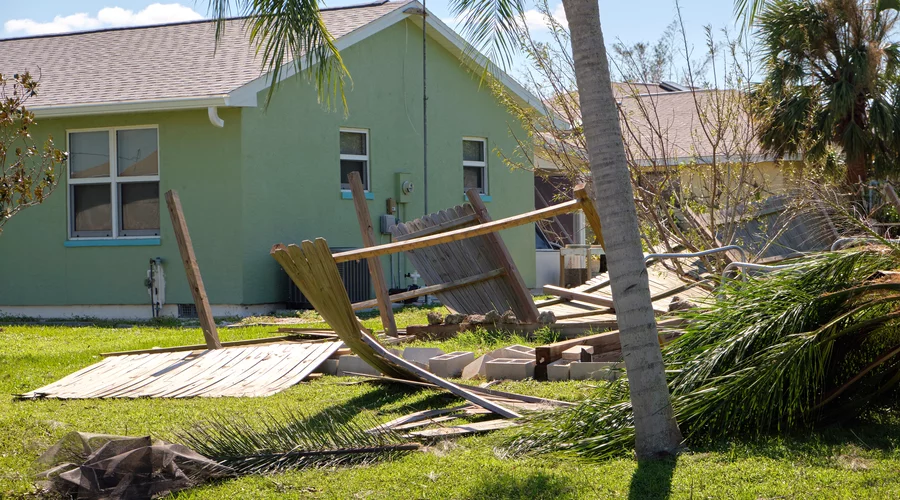

Hurricane wind damage is the part of a storm everyone pictures, and most of what people picture is wrong. Wind alone, even at Category 4 speeds, rarely shatters a properly installed window or rips sheathing off a code-built roof. What does the damage is the stuff the wind is carrying: a patio chair from three houses down, a section of vinyl fence, a piece of roof decking off a 1980s shingle home, a trampoline frame that lifted out of someone's yard at 65 mph.
Once one opening fails, the house pressurizes from the inside, and that internal positive pressure peels the roof off and turns a survivable storm into a total loss. Research by Behr and Minor after Hurricane Andrew documented this cascade: most catastrophic structural failures in 1992 traced back to a single shattered window or a garage door that buckled inward. The 2024 Helene/Milton building performance study by UF and Auburn assessed 358 structures and found zero post-FBC homes destroyed; pre-FBC homes around them were destroyed at a 46% rate.
This article covers what the wind picks up, the standardized debris missile your windows are tested against, the tornadoes hurricanes spawn, and a yard checklist. We install impact windows for a living, but the yard is where the storm starts. If your yard is full of missiles, no envelope holds.
The hurricane secret: it's the debris, not the wind
A clean, sustained 130 mph wind hitting a flat wall is a load engineers know how to design for. Florida code uses ASCE 7-22 wind maps, and any post-2002 home is built to handle the loads for its zone. The component that fails is almost never the wall. It is the opening: a window, a sliding glass door, a garage door, a soffit panel. And the opening fails because something hit it.
Wind-borne debris causes 60 to 70% of window failures during hurricanes. The Behr and Minor survey after Andrew, conducted across 17 buildings from Miami to Cutler Ridge, established the basis: impacts from windborne debris were the dominant cause of glass failure, and preventing "blow-through" after internal pressurization significantly mitigated structural damage. The NHC Tropical Cyclone Report on Hurricane Andrew and every major FEMA MAT report since (Charley, Wilma, Michael, Ian, Helene, Milton) repeats it.
Wind is a distributed pressure across the wall surface. Debris is a concentrated kinetic load delivered to a single point at high speed. A 9-pound 2x4 at 50 feet per second carries about 350 foot-pounds of kinetic energy on a 3-square-inch contact patch. Glass that holds against thousands of pounds of distributed pressure cannot hold that point load. The window breaks. Wind enters. Internal pressure spikes. The roof is now being lifted from below and sucked from above at the same time.
The conversation about hurricane protection is really a conversation about debris. The wind is mostly the delivery mechanism.
What 130 mph actually picks up
At 30 feet of elevation, large debris accelerates to between one-third and one-half of the prevailing wind speed. A Cat 4 storm with sustained 130 mph winds moves large objects at 43 to 65 mph. A 6-foot pine branch at 50 mph is doing the work of a small car at low speed.
Walk your block and inventory what is loose: patio chairs, planter pots, garbage cans, pool toys, a Weber grill, a wheelbarrow, gardening tools, a trampoline. Across 30 houses, that is a few thousand projectiles. Add roof contributions: loose tiles, old shingles, fascia, soffit panels. The ARA HurMis simulation used by UF in the 2025 Wind-Borne Debris Region study modeled a 1,000-by-1,000-foot neighborhood with 84 houses and counted 1,800 asphalt shingle components plus 84 roof deck panels per block as potential missiles.
Here is a rough reference table for Cat 4 wind speeds. Kinetic energy uses 0.5 × m × v², with debris velocity at one-third to one-half of wind speed depending on aerodynamics. Approximations, not specifications.
| Object | Mass | Velocity at 130 mph wind | Kinetic energy |
|---|---|---|---|
| TAS 201 missile (9-lb 2x4) | 9 lb | 50 ft/s (test standard) | ~350 ft-lb |
| Aluminum patio chair | 12 lb | ~70 ft/s (~48 mph) | ~915 ft-lb |
| Empty trampoline frame | 75-100 lb | ~50 ft/s (~34 mph) | ~3,100-4,200 ft-lb |
| 6-foot pine branch | 30 lb | ~75 ft/s (~51 mph) | ~2,600 ft-lb |
| Concrete roof tile | 4 lb | ~80 ft/s (~55 mph) | ~400 ft-lb |
| Garbage can (empty) | 25 lb | ~70 ft/s (~48 mph) | ~1,900 ft-lb |
| Plastic Adirondack chair | 8 lb | ~80 ft/s (~55 mph) | ~800 ft-lb |
| Section of vinyl fence | 15 lb | ~65 ft/s (~44 mph) | ~990 ft-lb |
The TAS 201 missile sits in the middle of this distribution. Anything at or below its energy level is what the test certifies a window against. Anything above it (a flying trampoline frame, a 6-foot branch coming sideways, a Weber grill) is territory the test does not cover. The most useful thing you can do for your envelope is keep that second category from existing in your neighborhood.
The TAS 201 missile test
When South Florida rebuilt its code after Andrew, engineers had to answer one question: what energy level should an impact-rated window survive? The answer became TAS 201-94, the Florida-specific large missile impact test for the High Velocity Hurricane Zone that governs Miami-Dade and Broward products today.
The protocol is simple to describe and brutal to pass. A pneumatic cannon fires a 9-pound section of Southern Yellow Pine 2x4 at the test specimen at 50 feet per second (about 34 mph). Three windows tested, two impacts each. Pass criteria: no complete penetration, interlayer intact, fragments stay adhered. After the missile test, the damaged specimen has to pass TAS 202 structural pressure cycling and TAS 203 cyclic wind pressure (9,000 cycles), because in a real hurricane the window has to keep working after the impact.
The 9-pound number was calibrated against the debris field observed during Andrew (representative construction debris: a stud, a roof framing member, a fence post). ASTM E1996, the broader national standard, defines five missile classes; TAS 201 maps to Missile Level D. Areas inside the Wind-Borne Debris Region but outside HVHZ use a 4.5-pound 2x4 at the same 50 fps.
For most homeowners this is background. The relevant fact: any impact-rated window installed under a current Florida product approval has been hit by that 9-pound 2x4 in a lab and survived. Glass might crack. The interlayer holds the fragments. The frame stays in the wall. The envelope does not breach.
Whether to meet WBDR opening protection with passive impact glass, deployable shutters, or pre-cut plywood is the question the plywood, hurricane shutters, or impact windows comparison addresses. They all stop the same missile. Some require less of you when the storm is two days out.
Hurricanes spawn tornadoes
Major hurricanes routinely produce dozens of tornadoes across their wind field, often hours after the eye has passed, often inland, often at night. The National Weather Service lists tornadoes as one of the five core hurricane hazards alongside surge, inland flooding, destructive winds, and rip currents. They get less press than surge and wind, partly because tornado tracks are short and warning lead time is so compressed.
The numbers from recent Florida storms:
- Hurricane Milton (October 2024) produced 46 confirmed tornadoes across Florida, several long-track EF-3s on the East Coast more than 100 miles from the Gulf landfall point. The UF/Auburn assessment of 120 structures in Milton tornado paths found 16% of pre-FBC homes destroyed and 0% of post-FBC homes destroyed, though garage door failures damaged even hardened homes.
- Hurricane Ian (September 2022) spawned tornadoes inland across Lee County and beyond, with damage more than three miles inland.
- Hurricane Michael (2018) produced wind-borne debris damage more than three miles inland from St. Andrew Bay, in areas not classified as WBDR under any ASCE 7 version.
The pattern is consistent. Hurricane-spawned tornadoes form in rain bands, usually in the right-front quadrant, and target inland areas long after the coastal surge threat has passed. Warning lead time is typically 5 to 10 minutes, sometimes less. No time to put up plywood. Barely time to reach an interior room.
For a homeowner in Palm Beach County or further inland, this changes the calculation. The hurricane track might miss you; the tornado embedded in a spiral band might not. Passive opening protection is the version of preparedness that does not require you to predict a 5-minute warning at 2 a.m.
The Wind-Borne Debris Region
Florida's building code formalizes the debris problem through the Wind-Borne Debris Region, the geographic envelope where impact protection or pre-approved coverings are required on new construction. The boundary is moving again.
The current 8th Edition FBC uses the older ASCE 7-16 definition: WBDR includes properties within one mile of the coastal mean high-water line where design wind speed is 130 mph or greater, plus any location where design wind speed is 140 mph or greater, plus the entire HVHZ (Miami-Dade and Broward at 170-180 mph).
The 2025 UF/ARA WBDR study by Dr. David Prevatt and Dr. David Roueche simulated debris across 30 representative Florida neighborhoods using the HurMis hurricane missile model. The conclusion: neighborhoods within 3,000 feet of a large inland water body in the 130-139 mph zone experience debris impact risk equivalent to or greater than the 140 mph Exposure B reference. The 9th Edition FBC (effective late 2026) will likely re-adopt an inland WBDR with a 3,000-foot boundary, adding new requirements for Central Florida lake counties (Lake, Polk, Seminole, Orange, Osceola, Volusia).
For South Florida homeowners, none of this changes practical reality. HVHZ requirements have always covered the entire region. If you live in Miami-Dade, Broward, or the Keys, your home is in the WBDR no matter how far inland it sits.
Yard checklist before the storm
The single most useful thing you can do in the 48 hours before a named storm hits is empty your yard. Every loose object is a missile waiting for the wind speed that will lift it. The threshold is lower than people expect: a Cat 1 moves plastic chairs and pool toys; a Cat 2 moves trampolines and grills; a Cat 3 picks up vinyl fence sections.
Most of this checklist is "before the season," not "before the storm."
| Item | Action | Timing |
|---|---|---|
| Outdoor furniture (chairs, table, umbrellas) | Bring inside the garage, lanai, or house | 24-48 hours before |
| Trash cans and recycling bins | Inside the garage | 24 hours before |
| Trampoline | Disassemble or relocate | Several days before, ideally never |
| Tree branches near roof or windows | Trim back at least 6 feet from the structure | Off-season (April-May) |
| Loose roof tiles or shingles | Re-secure or replace | Off-season |
| Pool toys, floats, kickboards | Inside the garage | 24 hours before |
| Garden tools, hoses, wheelbarrows | Inside the garage or shed (locked) | 24 hours before |
| Boats and kayaks | On a trailer, indoors, or strapped down | 48 hours before |
| Window planters and hanging baskets | Inside the house | 24 hours before |
| BBQ grill | Inside the garage; close propane | 24 hours before |
| Patio umbrella stands (heavy concrete) | Inside or on its side, weighted | 24 hours before |
| Lanai screens | Lower or remove if your system supports it | 24-48 hours before |
| Loose fence sections | Re-screw posts, add bracing | Off-season |
| Garbage day pickup | Confirm last pickup before storm | When storm is named |
| Pet houses, dog runs, chicken coops | Bring pets inside; secure or disassemble structures | 24 hours before |
A useful test: if you can pick it up and walk it 20 feet without straining, the wind can pick it up too. Anything in that category goes inside.
The off-season items are where homeowners under-invest. Tree trimming is far easier in April than late August. Roof tile inspection in May costs a few hundred dollars; the same job after a storm competes with thousands of emergency repairs.
The trampoline problem
Trampolines show up in every honest hurricane prep conversation in Florida and almost no checklist talks about them.
A 14-foot frame weighs 75 to 100 pounds. With the net, springs, and pad, it pushes 150. The shape is a parachute: large surface area, hollow underside, low drag once moving. In a Tropical Storm-force gust, unanchored trampolines start to move. In a Cat 2, they go airborne. In a Cat 3 they have been documented traveling several blocks before coming down on someone else's roof or car.
There is an unspoken rule in established Florida neighborhoods, especially older HOAs: nobody owns a trampoline. The neighbors who lost a windshield to a flying trampoline in Charley or Wilma made their feelings known years ago. New transplants from non-hurricane states sometimes buy one for the kids in March, and long-time residents stay quiet until August.
The practical options:
- Disassemble for the season. Most trampolines come apart in 30-45 minutes with two adults and a wrench. Reassemble in November.
- Anchor it permanently. Heavy-duty anchor kits use 4 corkscrew stakes driven 18 inches into the ground. They hold through 60-70 mph winds. Above that, anchors fail.
- Sell or donate it. The option most Florida natives recommend. A cheap aboveground pool uses the same yard space and is far less aerodynamic.
The trampoline in your yard is your liability and a missile aimed at the roof of the house behind you.
Trees: trim early, not late
Trees are the second-largest debris source after building components. Species choice matters. Live oak holds up well. Slash and longleaf pines are tall and brittle. Australian pine is invasive, shallow-rooted, and notorious for falling in tropical storms. Royal palms drop fronds; queen palms drop entire crowns. Mango and ficus shed limbs heavily.
Trim trees during the off-season, not the day before a storm. Every certified arborist in the region is booked solid in August, and trees pruned shortly before a storm have open wounds that increase vulnerability. The window in Florida runs January through May.
Targets in a pre-season trim:
- Branches within 6 feet of the roof, walls, or windows. A branch hanging over a window is a guaranteed point-blank impact in a Cat 2.
- Dead or diseased limbs. First to fall, most common source of strike damage in moderate storms.
- Crown thinning on dense canopies. Reducing density 15-25% lets wind pass through rather than catching the canopy as a sail. Do not over-thin.
- Anything growing into power lines. FPL handles this for free.
A homeowner with mature trees on a half-acre lot in Broward or Palm Beach County might spend $800 to $2,000 on a thorough pre-season trim. The same job after a storm runs $4,000 to $10,000.
After the storm: chainsaw safety and Sawzall alternatives
Post-storm cleanup is where avoidable injuries happen. Every hurricane season, Florida ERs see a wave of chainsaw lacerations, ladder falls, and electrical injuries. The pattern is so consistent that the CDC publishes specific post-hurricane safety guidance.
- Reciprocating saws (Sawzalls) handle most debris a homeowner needs to cut. A 6-amp Sawzall with a pruning blade cuts through a 6-inch oak limb in 30 seconds and is essentially impossible to lose a limb to. For branches up to 10 inches, a Sawzall is the right tool.
- If you have not used a chainsaw, do not start during recovery. Kickback injuries happen to inexperienced operators cutting branches under load. The branches in your yard after a storm are exactly that. Hire someone or wait for a neighbor with experience.
- Treat all downed lines as live. Stay 35 feet away. Call FPL.
- Wear safety gear. Chaps, ear protection, eye protection, sturdy boots.
- Take photos before you cut. A 10-second video of damage before cleanup is the difference between a paid insurance claim and a denied one.
The deeper home-hardening work (roof straps, garage door upgrade, impact glazing on east-facing openings) is covered in the five-year plan to harden a Florida home against hurricanes. The yard is the cheapest layer and the highest payoff.
How the yard fits into the bigger picture
Yard prep is one slice of a bigger effort. The hub guide on hurricane prep for Florida homeowners frames the full sequence. If you are in your first season, the Florida hurricane season newcomer guide is the lower-anxiety entry point. The yard checklist here is enough to get through your first June. If you are already a Florida veteran reading this in May, the reminder is to do the off-season items now while it is still cool out.
Next Steps
- Walk your yard with the checklist this weekend. Anything you cannot bring inside or anchor goes on the off-season fix list.
- Schedule a tree trim by end of May. Call a licensed arborist now. The August calendar is already filling up. Target branches within 6 feet of the roof.
- Resolve the trampoline question. Disassemble for the season, sell, or invest in serious anchoring with the understanding that anchors only buy you Cat 1-2 protection.
- Check your roof tiles or shingles. Walk the perimeter from the ground with binoculars. Any visibly loose pieces are tomorrow's missiles.
- Read the plywood, hurricane shutters, or impact windows comparison. Once your yard is clean, the envelope itself is the next layer.
- If you are thinking about long-term envelope hardening, request a free in-home estimate. We walk your house, look at exposure, and give you a plain-spoken assessment. The My Safe Florida Home program helps offset costs for qualifying homeowners.