
Two Storms, One Question
In the fall of 2024, Florida was struck by two major hurricanes within two weeks. Two in one season is not unusual for this state: our analysis of the hurricane record finds that south Florida's hurricanes in particular arrive in clusters, Miami's 28 nearby hurricanes since 1900 falling in just 22 different years, and that a season with a second storm is a planning problem of its own, since recovery from the first can be interrupted by the next. Hurricane Helene made landfall on September 26 as a Category 4 storm with 140 mph sustained winds on the Big Bend coast, the strongest hurricane to hit that region since reliable records began. Two weeks later, Hurricane Milton made landfall near Siesta Key as a Category 3 with 120 mph sustained winds, spawning 46 confirmed tornadoes across Florida's east coast, including three rated EF-3.
Between them, the two storms killed over 290 people and caused more than $110 billion in damage. Helene alone was the deadliest U.S. hurricane since Katrina in 2005.
But within the destruction, the data told a clear story about which homes survived and which didn't.
The Study
University of Florida (Dr. David Prevatt, Dr. Kurt Gurley) and Auburn University (Dr. David Roueche) deployed assessment teams after both storms to systematically evaluate how residential structures performed. Their report, submitted to the Florida Department of Business and Professional Regulation in June 2025, is the most comprehensive post-hurricane building performance study since Hurricane Andrew.
What they assessed:
- 358 total structures (173 on-site inspections, 185 virtual assessments using aerial imagery)
- 221 structures in Helene's coastal hazard zones (Taylor, Dixie, Levy, and Citrus counties)
- 120 residential structures in Milton's tornado damage paths (St. Lucie, Martin, Brevard, and Volusia counties)
- 17 additional structures revisited from earlier Hurricane Michael (2018) assessments
How they categorized damage: Each structure was rated on a six-level scale: negligible, slight, moderate, heavy, partial destruction, and destruction (collapsed, shifted off foundation, or structurally non-recoverable).
How they divided the housing stock:
- Pre-FBC: Built before March 1, 2002 (when the statewide Florida Building Code took effect)
- Post-FBC (2002-2017): Built under the first through sixth editions of the FBC
- Post-FBC (2018-2024): Built under the seventh and eighth editions, incorporating ASCE 7-16 and ASCE 7-22 wind loads
The Numbers
Hurricane Helene: Coastal Wind and Surge
Helene's Big Bend coast landfall produced 140 mph sustained winds and storm surge reaching 17.5 feet in Taylor County. The surge destroyed roughly 80% of buildings in Keaton Beach and Steinhatchee and 70% of Horseshoe Beach. Among the 221 structures assessed:
| Damage Level | Pre-FBC (178 structures) | Post-FBC (43 structures) |
|---|---|---|
| Negligible to Slight | 30% | 64% |
| Moderate | 9% | 18% |
| Heavy | 15% | 18% |
| Destroyed | 46% | 0% |
Zero post-FBC structures were destroyed. Not one. Out of 43 post-code homes assessed in the same coastal hazard zones where nearly half of the pre-code homes were completely destroyed.
All 78 structures that collapsed or shifted off their foundations were pre-FBC. Every single one.
39% of all assessed structures experienced no observable damage to their main living areas. But that figure masks the stark divide: pre-code homes clustered at the extremes (either untouched or destroyed), while post-code homes clustered in the lower damage categories even when located in the same neighborhoods.
Hurricane Milton: Tornadoes on the East Coast
Milton's most unusual feature was its tornado outbreak. 46 confirmed tornadoes formed, including three rated EF-3, the first time a single hurricane produced more than one EF-3 tornado since records began in 1995. The tornadoes tore through developed residential communities on Florida's east coast, far from Milton's actual landfall point.
The researchers assessed 120 residential structures in tornado damage paths:
| Damage Level | Pre-FBC | Post-FBC (2002-2017) | Post-FBC (2018-2024) |
|---|---|---|---|
| Negligible to Slight | 55% | 67% | 69% |
| Moderate | 19% | 28% | 28% |
| Heavy | 10% | 5% | 3% |
| Destroyed | 16% | 0% | 0% |
Again: zero post-FBC homes were destroyed. In tornado paths. Against EF-3 tornadoes.
16% of pre-FBC homes were destroyed. 26% experienced heavy damage or worse. Only 55% had negligible or slight damage.
The newest homes (built 2018-2024 under the most recent code editions) performed slightly better than the 2002-2017 cohort, with only 3% experiencing heavy damage compared to 5%. The building code isn't static. Each edition improves on the last, and the data shows the improvement.
The assessment zones skipped the Tampa Bay metro, but the region lived both storms. Helene never came ashore there (its center passed more than 100 miles offshore) and still did its worst damage as surge. Milton, 13 days later, was the wind event: winds modeled around 99 mph at Tampa, with landfall at Siesta Key. Surge is a flood problem no glazing solves; wind is exactly the load impact windows in Tampa, St. Petersburg impact windows, and impact windows in Sarasota are rated to carry.
What Failed and What Didn't
The numbers tell the headline story: code-compliant homes survive. But the details matter because they show homeowners exactly which components are critical.
Impact Windows: They Worked
Across both storms, impact-rated windows and doors performed their primary function. Laminated glass cracked on impact but stayed in the frame, keeping the building envelope sealed and preventing the internal pressurization cascade that destroys homes from the inside out.
One isolated exception: in the Cobblestone neighborhood in St. Lucie County, a piece of roof decking from a neighboring structure struck an impact window during an EF-3 tornado. The missile penetrated the glass. This was a single occurrence across hundreds of assessed structures, and the debris (a large structural panel traveling at tornado speeds) exceeded the loads that impact windows are designed and tested for. The 9-lb 2x4 projectile used in TAS 201 testing simulates wind-borne debris at hurricane speeds, not structural panels at tornado speeds.
The researchers also revisited homes in Mexico Beach that had been assessed after Hurricane Michael (2018). Impact windows installed there with design speeds of 130-136 mph had withstood estimated actual winds of 150 mph during the Category 5 storm. The laminated glass cracked in several units but remained in the frames, preventing envelope breach. Seven years later, these windows are still in service.
Garage Doors: The Weak Link
This was the most actionable finding in the study, and it directly affects homeowners who believe their homes are fully protected.
In the Cobblestone neighborhood (post-FBC construction, built 2019 and later), only two homes suffered structural roof damage during the EF-3 tornado. Both had garage doors facing the tornado. The sequence in each case was identical:
- Asphalt shingle debris from pre-FBC homes struck the garage door at high velocity
- The garage door, rated at DP 36 PSF, was breached by the combination of wind pressure and debris impact
- Hurricane-force wind rushed into the garage
- Internal pressurization built up inside the home
- Roof decking uplifted from the inside
The rest of the Cobblestone homes, with garage doors oriented away from the tornado's approach, survived intact.
The problem is systemic, not specific to one product. Florida Building Code Section 609.4 allows garage doors to be designed for only 60% of ASCE 7 wind pressures, while windows and doors must meet full design loads. The researchers described garage doors as potential "damage amplifiers" and noted that current FBC provisions "do not appear to provide adequate resistance to combined wind-pressure and windborne debris impact." This finding is expected to drive changes in the 9th Edition FBC.
For homeowners: your impact windows, impact doors, and roof connections can all be code-compliant, but if your garage door fails, the resulting internal pressurization can still take the roof off. A wind-rated garage door replacement ($800-$2,500) or even a bracing kit ($300-$800) addresses the single most overlooked weak point in most Florida homes.
Roof Sheathing Fasteners: A Subtle Problem
In every observable roof decking failure across both storms, the failure mechanism was the same: fastener head pull-through. The nail or screw didn't pull out of the rafter. The fastener head punched through the plywood or OSB sheathing panel.
This matters because of a trade-off in modern fastener technology. The transition from smooth-shank nails to ring-shank nails (required by current code) increased withdrawal resistance by approximately 50%, which prevents the nail from sliding out of the rafter. But ring-shank nails have slightly smaller heads relative to their shank, and the ring-shank design can score the sheathing during installation, reducing pull-through capacity.
The problem is compounded by overdriven nails, a common defect with pneumatic nail guns. When the gun drives the nail too deep, the head breaks through the surface layer of the sheathing, reducing pull-through capacity by approximately 15%. On a roof with hundreds of fastener points, even a small percentage of overdriven nails creates weak spots that become failure initiation points under uplift loads.
The researchers noted this as a quality control issue rather than a code issue. The code requires appropriate fasteners. The challenge is ensuring they're installed correctly across thousands of connection points on every roof.
The Martin County Retrofit Case Study
The researchers assessed 66 homes in Stuart, Florida that were affected by an EF-2 tornado during Milton. Many of these homes had been retrofitted with various hurricane hardening improvements:
| Retrofit Type | Number of Homes |
|---|---|
| Re-roofing | 57 |
| Impact windows or shutters | 19 |
| New garage doors | 13 |
| Roof deck re-nailing | 8 |
The results were encouraging overall, but one case illustrates a critical lesson. A home built in 1977 had been retrofitted in 2017 with impact windows and in 2020 with a new metal roof. During the EF-2 tornado, the impact windows performed perfectly. The laminated glass held. The building envelope remained sealed at every window opening.
But the home still lost approximately 40% of its roof. The failure mechanism: fastener pull-through in the roof sheathing. The metal roof panels were properly attached to the sheathing, and the sheathing-to-rafter connections used the original 1977 fasteners. The weakest link in the chain wasn't the windows or the roof covering. It was the 47-year-old nails holding the plywood to the rafters.
Impact windows are necessary but not sufficient. They prevent the envelope breach cascade that causes the most catastrophic failures. But the building envelope is a system, and the weakest component determines overall performance. If the roof deck attachment is inadequate, the roof can fail even when every window and door holds.
This is why the My Safe Florida Home program covers roof-to-wall connections and roof deck attachment alongside impact windows, and why a comprehensive hurricane hardening approach addresses all components in priority order.
What the Code Got Right
The Prevatt/Roueche study confirms what three decades of building code development have aimed for:
The continuous load path works. Post-FBC homes with engineered connections from roof to foundation maintained structural integrity even in Category 4 winds and EF-3 tornadoes. When every connection in the chain is designed to transfer wind forces from the roof through the walls to the foundation, the structure stays intact.
Impact-rated opening protection prevents the failure cascade. The envelope breach mechanism (a broken window creates 30-60 PSF internal pressure that combines with 40-80 PSF external roof suction to produce 70-140 PSF of uplift) is what destroyed most homes during Hurricane Andrew in 1992. Impact windows and doors eliminate this mechanism. Across 358 structures in the Helene/Milton study, the researchers found no cases where properly functioning impact glazing led to structural failure.
The cost is modest. Impact-resistant fenestration adds only 1.7% to 2.7% to new construction cost, according to a University of Florida cost-benefit study. The benefit-cost ratio (reduction in insured losses over a 10-year period) ranges from 61% to 110%, meaning impact windows can pay for themselves in avoided damage within a single decade, before insurance savings are factored in.
What the Code Needs to Fix
Garage door requirements. The 60% ASCE 7 allowance for garage doors was exposed as insufficient during Milton's tornadoes. The 9th Edition FBC is expected to address this.
Fastener quality control. The ring-shank nail pull-through pattern and the overdriven nail problem are installation quality issues, not code specification issues. But the code could require post-installation verification (e.g., inspector pull-tests on sample fasteners) to catch overdriven nails before they're covered by roofing material.
Sliding glass door water performance. While separate from the structural findings, the broader FBC research program has identified water intrusion through sliding glass door tracks as a gap between testing standards and real hurricane conditions. The 9th Edition is expected to increase water test pressures.
What This Means for Your Home
If Your Home Was Built Before 2002
Your home predates the modern Florida Building Code. It was built under one of 400+ local codes that existed before the statewide FBC unified standards. The data from Helene and Milton is unambiguous: pre-code homes are destroyed at rates of 16-46% in major hurricanes. Post-code homes are destroyed at 0%.
This doesn't mean your home will be destroyed in the next storm. Many pre-code homes survived both Helene and Milton. But the probability of catastrophic damage is categorically higher.
The most impactful upgrades, in priority order:
- Roof-to-wall connections (hurricane straps): the number one structural failure point. $1,500-$3,000 to retrofit.
- Opening protection (impact windows, impact doors, wind-rated garage door): prevents the envelope breach cascade. $15,000-$50,000+ for a whole home.
- Roof deck attachment (re-nailing with ring-shank nails at enhanced spacing): prevents sheathing pull-through. Typically done during a reroof.
- Secondary water resistance (peel-and-stick membrane on roof deck): prevents water intrusion if roof covering fails. $500-$2,000 added to a reroof.
The My Safe Florida Home program provides grants up to $10,000 for these improvements, and the free wind mitigation inspection alone can lower your insurance premiums by documenting your home's existing features.
If Your Home Was Built After 2002
Your home was built to modern code standards, and the Helene/Milton data confirms those standards work. But "code compliant" doesn't mean "invulnerable." The two post-FBC homes that suffered roof damage in Cobblestone both met code. Their garage doors met code. The code just wasn't strong enough for the loads they faced.
Check your garage door. If it's the original builder-grade unit, it was rated to the minimum code requirement. Replacing it with a higher-rated wind or impact door ($800-$2,500) eliminates the single most likely point of failure in an otherwise well-built home.
Also check that your wind mitigation inspection is current (valid for 5 years) and that you're receiving all the insurance discounts your home qualifies for. Post-FBC homes with impact windows, hip roofs, and proper roof connections often qualify for wind premium discounts of 50% or more.
If You're Building New
Build to exceed code, not just meet it. The additional cost is minimal (1.7-2.7%), and the Helene/Milton data provides the strongest evidence yet that code compliance provides categorical protection. Specify:
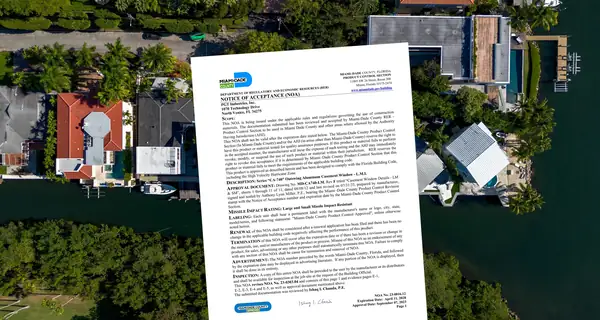
- Impact-rated glazing on all openings (Miami-Dade NOA products if in the HVHZ)
- Hip roof design (distributes wind pressure evenly, earns a 28-32% insurance discount)
- Enhanced roof deck attachment (ring-shank nails at 6"/6" spacing)
- Secondary water resistance
- A garage door rated above the minimum code requirement
The Bigger Picture
Florida's building code was born from catastrophe. Hurricane Andrew in 1992 destroyed 63,500 homes, bankrupted 16 insurance companies, and exposed the fatal weakness of unregulated construction in hurricane zones. The South Florida Building Code (1994) and the statewide FBC (2002) were the response.
Since then, every major hurricane has produced data that validates the code and drives further improvement:
| Hurricane | Year | Key Lesson | Code Response |
|---|---|---|---|
| Andrew | 1992 | Envelope breach cascade destroys homes | HVHZ established; impact glazing required |
| 2004 Season (Charley, Frances, Ivan, Jeanne) | 2004 | Post-code homes survived dramatically better | FBC validated; demand surged |
| Wilma | 2005 | High-rise glass failures above 30 feet | Laminated glass required above 30 ft |
| Michael | 2018 | Panhandle codes too weak; Mexico Beach devastation | Calls for statewide strengthening |
| Ian | 2022 | Surge destroys regardless of wind protection; post-code homes survived wind | Enhanced flood/surge provisions |
| Helene/Milton | 2024 | Zero post-FBC destruction; garage doors are the weak link | 9th Edition expected to strengthen garage door requirements |
The 2024 data point is the strongest yet. Not because the numbers are different (post-code homes have outperformed pre-code homes after every storm), but because the sample size and methodological rigor are the most comprehensive to date, and because the result is zero. Not "lower." Not "significantly reduced." Zero homes destroyed.
The Florida Building Code is not perfect. Garage doors are under-specified. Water testing for sliding glass doors doesn't match real conditions. Fastener quality control depends on individual installer care. But as a system, the code achieves what it was designed to achieve: homes that survive hurricanes.
Next Steps
- Check when your home was built. Pre-2002 homes face categorically higher risk and benefit most from retrofits. The My Safe Florida Home program can help fund upgrades.
- Assess your garage door. If it's the original builder unit, consider a wind-rated or impact-rated replacement. This is the single most cost-effective upgrade for post-FBC homes.
- Get a free estimate for impact windows, doors, and a complete opening protection assessment matched to your home's code requirements.
- Get a wind mitigation inspection to document your home's current features and ensure you're receiving all available insurance discounts.
- If building new, specify above-code features. The marginal cost is 1.7-2.7%. The protection is categorical.