What Makes Pivot Doors Different
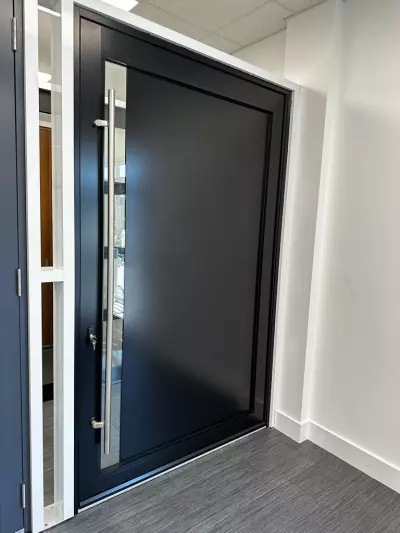
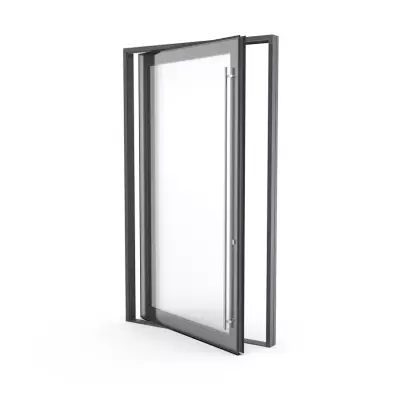
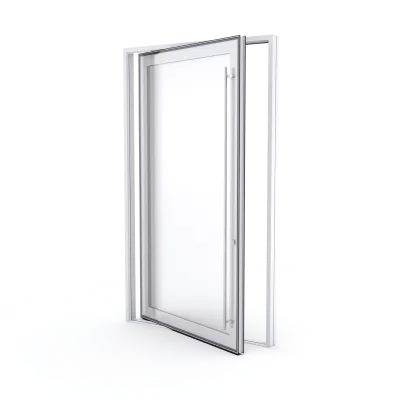
A pivot door rotates on a central vertical axis using pivot hinges mounted at the top and bottom of the door panel rather than conventional side-mounted hinges attached to the frame. This fundamental difference in how the door operates changes everything about its size, weight capacity, and architectural presence.
Standard hinged doors, the kind on virtually every home in Florida, are limited by what side-mounted hinges can support. Three or four hinges screwed into a wooden or aluminum frame can handle a door that's about 3 feet wide, 7 feet tall, and 50-100 lbs. Push much beyond those dimensions and the hinges start to sag, the frame twists, and the door binds.
Pivot doors eliminate this constraint entirely. The pivot mechanism transfers the door's weight straight down through the floor and straight up through the header, using the building's structure rather than the frame to carry the load. This means a pivot door can be 4-5 feet wide, 8-10 feet tall (some configurations reach 12 feet), and weigh 500-1,500 lbs or more depending on materials and glass configuration.
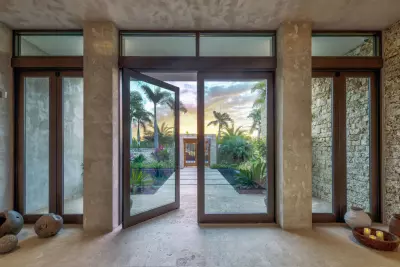
The pivot point itself is typically offset, positioned about one-third from one edge rather than centered. This creates an asymmetric swing: one side of the door swings inward while the other swings outward, producing the dramatic, sculptural motion that has made pivot doors the architectural centerpiece of modern and contemporary homes across South Florida.
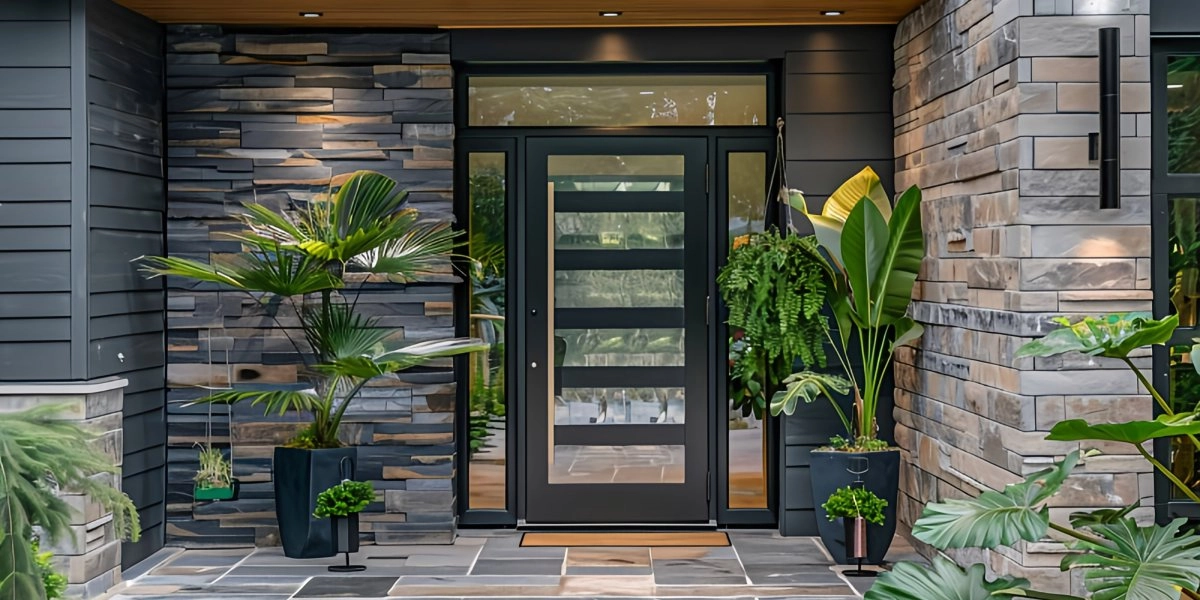
The result is a front entry that commands attention. Where a standard 3x7 door disappears into the facade, a pivot door announces the home. It's the single most impactful architectural upgrade available for a Florida entry, and when it carries a hurricane impact rating, it does this while providing full Category 5 protection.
Why Hurricane-Rating a Pivot Door Is Harder Than a Standard Door
Getting a hurricane impact rating on a pivot door is a significantly more demanding engineering challenge than rating a standard entry door. Every dimension that makes pivot doors architecturally impressive also makes them structurally demanding under hurricane conditions.
Surface Area and Wind Force
Wind force on a door is directly proportional to its surface area. A standard 3x7 ft entry door has about 21 square feet of surface. A 5x10 ft pivot door has 50 square feet, more than double the area. Under the same wind pressure, the pivot door absorbs more than twice the total force.
This means a design pressure rating that's perfectly adequate for a standard entry door may be dangerously insufficient for an oversized pivot door. Where a standard entry might need DP +40/-40, an oversized pivot door in the same location may require DP +60/-80 or higher depending on the wind zone, exposure category, and the door's position on the building.
Design Pressure Variables
Several factors compound to increase the design pressure requirements for pivot doors:
Wind zone. In the HVHZ (Miami-Dade and Broward Counties), the design wind speed is 175-170 mph. Pivot doors installed in the HVHZ must carry a Miami-Dade NOA, a Notice of Acceptance from Miami-Dade's Product Control division, the most stringent product approval process in the country.
Exposure category. Exposure D (waterfront properties with unobstructed wind approach over open water) requires 40-60% higher design pressures than Exposure B (suburban areas with surrounding buildings and trees providing some wind shielding). A pivot door on a waterfront home in Sunny Isles Beach faces dramatically different engineering demands than the same door on a tree-lined street in Coral Gables.
Zone location on the building. Zone 5 (the corners of a building where wind accelerates and creates turbulent vortices) requires higher negative (suction) DP ratings than Zone 4 (the center of a wall). If your pivot door is near a building corner, the negative pressure requirements increase.
Height factor. Wind speed increases with height above ground. If the pivot door serves an upper-floor entry (a penthouse, an elevated townhome, or a home on a raised foundation), the Kz velocity pressure exposure coefficient increases the design pressure requirements beyond what ground-level calculations would indicate.
Cyclic Pressure Testing
Hurricane winds are not constant. They gust, shift, and create oscillating positive and negative pressures on every opening in a building. The Florida Building Commission requires that impact-rated products withstand cyclic pressure loading per TAS 203: 9,000 pressure cycles that simulate the repeated push-and-pull of sustained hurricane-force winds.
For a pivot door, this testing is especially demanding because the pivot mechanism (the top and bottom pivot points, the bearings, the structural connections) must maintain alignment and seal integrity through all 9,000 cycles. Any loosening, shifting, or deformation of the pivot hardware under cyclical loading would compromise both the structural integrity and the weatherseal.
The Weatherseal Challenge
Standard hinged doors compress directly against the frame when closed. The hinge side is fixed, and the latch side pulls the door into weatherstripping that lines the frame. This compression seal is straightforward to engineer and test.
Pivot doors rotate. The relationship between the door panel and the frame is geometrically different from a hinged door. The panel doesn't press flat against a single plane; it sweeps through an arc. This means the weatherseal must work on all four edges using specialized compression seals that maintain contact and pressure regardless of the door's rotational position when fully closed. Designing and certifying these seals for hurricane conditions adds complexity and cost that standard hinged doors don't face.
Multi-Point Locking: The Most Critical Hardware Decision
A multi-point locking system is not optional on a hurricane-rated pivot door. It is the single most important hardware component for storm protection.
Here's why: a standard single-point deadbolt engages the frame at one location, typically about 36 inches above the floor. On a 7-foot door, that single lock point is roughly in the middle of the door's height. The door can flex above and below the lock, but the distances are manageable.
On a 10-foot pivot door, a single lock point at 36 inches would leave 6+ feet of unsecured door above it and 3 feet below. Under hurricane wind pressure, the unsecured portions of the door would bow away from the frame, breaking the weatherseal and creating progressively larger gaps as wind speed increases. The stress concentration at the single lock point would be extreme: all the wind force acting on 50 square feet of surface, resisted at one point.
Multi-point locking systems solve this by engaging the frame at 3-7 points distributed along the full height of the door:
| Lock Configuration | Lock Points | Best Application |
|---|---|---|
| Standard multi-point | 3 points (top, middle, bottom) | Moderate DP, smaller pivot doors |
| Enhanced multi-point | 4-5 points (distributed) | Higher DP, HVHZ applications |
| Full-perimeter multi-point | 5-7 points (all edges) | Maximum DP, oversized doors, waterfront |
Each lock point transfers wind load to the frame, distributing the force across the entire perimeter rather than concentrating it at a single location. The result is dramatically lower stress at each individual point, better seal compression under pressure, and a door that maintains its structural plane under the worst conditions a Florida hurricane can produce.
When evaluating pivot door products, verify the multi-point lock configuration and confirm that it's included in the product's impact certification. The lock system must be tested as part of the complete assembly; a door certified with a 5-point lock does not carry that rating if installed with a 3-point lock.
Manufacturers Offering Impact Pivot Doors
The market for hurricane-rated pivot doors is smaller and more specialized than the market for standard impact doors. These are the manufacturers currently serving the Florida hurricane zone market with certified impact pivot door products.
ECO Window Systems
The most affordable major manufacturer with Miami-Dade approval. ECO offers pivot doors up to 132 inches (11 feet) with transom configurations. Full aluminum construction. ECO has positioned itself as delivering hurricane-grade protection at a budget-friendly price point, and their pivot door products maintain this value proposition.
ECO's pivot doors share the same engineering platform as their Series 950 French doors, including multi-point locking hardware and Miami-Dade NOA certification. For homeowners who want the architectural impact of a pivot door without the ultra-premium price tag, ECO is the starting point.
Best for: Budget-conscious modern builds, first-time pivot door buyers, projects where the pivot door needs to match other ECO windows and doors throughout the home.
WinDoor (MITER Brands): Estate Series
The luxury benchmark. WinDoor's Estate Series pivot doors represent the highest tier of hurricane-rated pivot door engineering. Design pressure ratings reach extreme levels suitable for the most demanding HVHZ and Exposure D applications. Premium hardware, ogee glazing beads, and stainless steel components are standard.
WinDoor's clientele includes Ritz Carlton, Walt Disney World, and Marriott properties, institutions where both aesthetic standards and structural requirements are uncompromising. Their Estate Series has earned the description "the gold standard in the luxury high-rise market," and the pivot door products reflect this positioning.
Best for: Luxury waterfront homes, penthouse entries, architectural showcase projects, applications requiring the highest available DP ratings.
ES Windows (Tecnoglass): Prestige Line
ES Windows' Prestige line includes pivot door options with a 3-inch frame depth and frameless butt glass corner configurations, a detail that allows the pivot door to extend to the corner of a building with glass meeting glass at a near-invisible joint. This creates a striking modern aesthetic that few other manufacturers can match.
As a Tecnoglass brand, ES Windows brings large-scale manufacturing capability and competitive pricing (typically 20% less than comparable PGT products, based on our project experience).
Best for: Contemporary architecture with glass corner details, projects pairing pivot doors with ES window systems, cost-competitive alternatives to WinDoor's premium tier.
PGT
PGT offers limited pivot door configurations through their custom programs. PGT's strength is their massive dealer network and brand recognition across Florida; the WinGuard name carries significant homeowner trust. For pivot doors specifically, their catalog is narrower than the dedicated manufacturers above, but they can accommodate custom requests through their higher-tier product lines.
Best for: Projects already specifying PGT WinGuard throughout the home, homeowners with strong PGT dealer relationships.
Pricing
Impact pivot doors are a premium product. The engineering complexity, oversized materials, specialized hardware, and limited manufacturer competition all contribute to pricing that sits well above standard impact entry doors.
| Configuration | Door Unit Only | Installed |
|---|---|---|
| Pivot door, 4x8 ft, standard laminated glass | $5,000-$8,000 | $7,000-$11,000 |
| Pivot door, 5x10 ft, laminated glass | $8,000-$12,000 | $11,000-$16,000 |
| Pivot door, 5x10 ft, insulated glass unit (IGU) | $10,000-$15,000 | $13,000-$20,000 |
| Pivot door with transom, oversized | $12,000-$15,000+ | $16,000-$20,000+ |
Factors That Move the Price
Door size. The primary cost driver. Every additional square foot of door increases material, glass, and hardware costs. A 4x8 ft door is substantially less expensive than a 5x10 ft door, which is substantially less expensive than a 5x12 ft custom configuration.
Glass configuration. Standard laminated impact glass is the baseline. Upgrading to an insulated glass unit (IGU), two panes of glass with an insulating air or argon gap, adds 25-40% but significantly improves energy efficiency. Low-E coatings, tinted glass, and decorative options add further.
Frame material. All impact pivot doors in the Florida market use aluminum frames (the weight and structural demands eliminate vinyl and fiberglass as frame options). The cost variation comes from the aluminum alloy grade, thermal break design, and finish quality.
Hardware finish. Standard anodized or powder-coated hardware is included in base pricing. Upgraded finishes (brushed nickel, oil-rubbed bronze, matte black, satin brass) add 10-20%. Premium stainless steel hardware packages (standard on WinDoor Estate) add more.
Premium finishes. Wood veneer interior cladding, Kynar or Duranar fluoropolymer exterior coatings, and custom color matching add 20-40% to the base door price.
Custom sizing. Non-standard dimensions, unusual pivot point locations, and configurations outside the manufacturer's standard catalog add 15-30%.
For context on how pivot door pricing compares to other impact door types, see our impact doors cost guide and impact windows cost guide.
Installation Complexity
Pivot door installation is not a standard door replacement. It is a structural project that may involve reinforcement of your home's foundation, framing, and threshold, work that standard impact door installations do not require.
Structural Reinforcement
The pivot mechanism concentrates the full weight of the door (500-1,500+ lbs) at two points: the floor pivot and the header pivot. A standard concrete slab is designed to distribute loads over broad areas. A pivot door asks that slab to support hundreds of pounds at a single point roughly the size of a fist.
In many installations, a structural engineer must verify that the concrete slab or foundation can handle these point loads without cracking or settling. If the slab is insufficient, reinforcement may be required: additional concrete, a steel bearing plate embedded in the slab, or modifications to the footer. The header above the door must similarly be engineered to carry the concentrated load at the top pivot point.
Precision Requirements
Pivot doors are less forgiving of out-of-square conditions than hinged doors. A hinged door can compensate for a slightly out-of-plumb frame through hinge adjustment. A pivot door that's installed in a rough opening that isn't precisely square and plumb will bind, drag, or fail to seal properly.
The rough opening must be built or modified to tight tolerances. On new construction, this is specified during framing. On retrofit installations, the existing opening may need to be rebuilt to achieve the required precision.
Threshold Integration
The threshold must accomplish two contradictory goals: maintain a watertight seal (critical for hurricane water intrusion protection) while allowing the pivot rotation without binding or dragging. This requires specialized threshold profiles and drainage channels that standard door thresholds don't include.
Timeline and Crew
Most pivot door installations require 2-3 days with a specialized crew, significantly longer than a standard entry door replacement (typically half a day to one day). The additional time accounts for structural assessment, precision preparation of the rough opening, hardware calibration, seal adjustment, and final testing.
Factor the installation timeline into your planning, particularly if the pivot door is your primary entry. You'll need an alternative entry point during installation.
Where Pivot Doors Shine in Florida
Pivot doors have found their natural market in South Florida's contemporary and luxury residential architecture. The communities where we see the highest demand reflect the intersection of modern design preferences, higher budgets, and demanding hurricane protection requirements.
Doral, Pinecrest, and Coral Gables. Modern contemporary new construction in these established communities frequently specifies pivot doors as the primary entry. The architectural style (clean lines, flat roofs, expansive glass) demands an entry door that matches the scale and aesthetic of the facade. A standard 3x7 ft entry door looks out of proportion on a modern home with 10-foot ceilings and floor-to-ceiling impact windows.
Miami Beach and Sunny Isles Beach. Luxury condo penthouses and waterfront townhomes. In these locations, the pivot door often serves as the unit entry within a high-rise corridor, or as the main entry to a townhome where the architectural statement begins at the door. Exposure D conditions (direct waterfront) and HVHZ requirements make the hurricane engineering non-negotiable.
Boca Raton and Delray Beach. Upscale renovations that blend traditional Florida architecture with modern interior design. Homeowners upgrading from Mediterranean or transitional styles often choose a pivot door to signal the home's evolution while maintaining HOA compliance.
Naples and Sarasota. Coastal modern homes on Florida's Gulf coast. While not in the HVHZ, these areas face significant hurricane exposure and require Florida Building Code-compliant impact products. The modern architectural movement along the Gulf coast has driven strong pivot door demand.
Any home where the entry is the architectural focal point. A pivot door makes the most sense when the front entry is visible, prominent, and designed to make a statement. If your entry is recessed, hidden, or secondary to the overall facade, the visual impact of a pivot door may not justify the premium.
Next Steps
- Get a free estimate for an impact pivot door matched to your opening dimensions, wind zone, and design preferences. We'll calculate the exact DP requirement for your address and recommend products that meet it.
- Determine your structural requirements early. If you're retrofitting a pivot door into an existing home, a structural assessment of the floor slab and header should happen before you order the doorânot during installation.
- Compare across door types if you're deciding between a pivot door, French doors, or sliding glass doors for a wide entry. Each serves a different aesthetic and functional purpose.
- Verify HVHZ compliance if you're in Miami-Dade or Broward County. The product must carry a Miami-Dade NOA, and your installer must pull a permit that references the specific NOA number. Learn more in our HVHZ guide.
- Browse the full impact door lineup on our impact doors page, covering entry doors, sliding glass doors, French doors, and pivot doors.