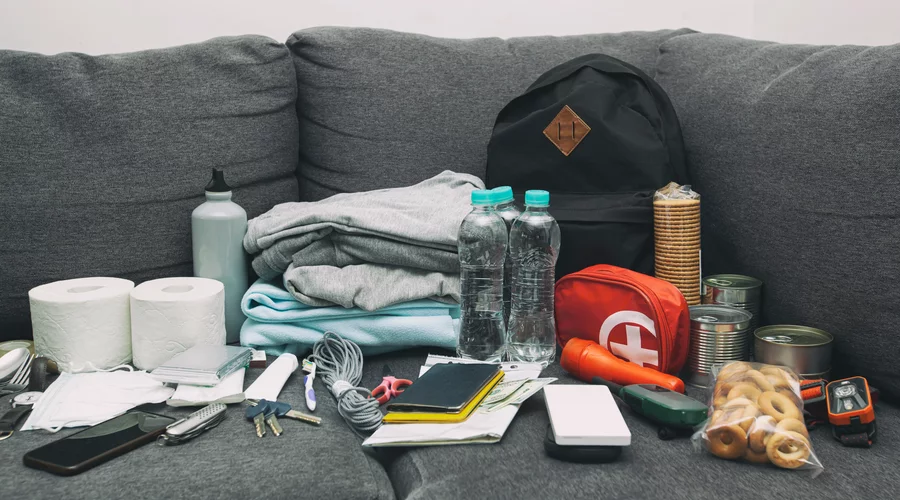

Florida hurricane supplies are the part of prep nobody pictures when they think about a hurricane. People picture the wind. After living through a few of these, the reality is that the wind lasts a day and the grid being down lasts a week. The supplies that decide whether that week is miserable or merely inconvenient have nothing to do with the storm itself: water, food, sanitation, fuel, cash, and a manual can opener you remembered to buy in May.
This is National Hurricane Preparedness Week, May 3-9, 2026, and one of the daily NWS themes is "Assemble Disaster Supplies." Ready.gov has a reasonable basic kit list. The trouble is that the federal default assumes a 3-day disruption, and Florida outages routinely run 7-14 days. Andrew left parts of Miami dark for six weeks; Irma, two; Wilma, ten days. Plan for seven days as a floor, not a ceiling.
The chain reaction when the grid goes down
Losing power is not a single event. It is a cascade. The lights go, then the AC goes, then the fridge starts its countdown. If you are on a private well, water pressure dies within minutes because the pump is electric. On municipal water, pressure holds for a few hours and then drops as tank levels fall and pumps stop refilling them.
Within a day, sewer goes. Lift stations (the pumps that move wastewater uphill through the municipal system) run on electricity. When they stop, the sewer backs up to whatever height the pipes can hold, and your toilet stops being a useful piece of plumbing. The phrase Florida veterans use is short and accurate: sewer runs on electricity.
By day two you are also dealing with the heat. South Florida in June is 90F with 80 percent humidity. With the AC down, the fridge warm, and the toilet not flushing, the house gets uncomfortable fast. The full experience of a multi-week Florida outage is its own piece. This one is about the supply side: what you actually need, and how much.
Drinking water: how much, how to store
One gallon per person per day. That is the Ready.gov number and the Florida Division of Emergency Management number, and it covers drinking plus light cooking and basic hygiene combined. Multiply by household, multiply by seven days, and that is your floor.
A family of four needs 28 gallons. Round up to thirty.
Storage options, in rough order of how Florida households actually do it:
- Gallon jugs from the grocery store. Cheap, stackable, about ten dollars for four. Buy in May, rotate so the oldest get used first.
- Bottled water cases. Easy to grab and hand out. Less space-efficient than gallons.
- Refilled containers. A clean 2-liter soda bottle, washed and tap-refilled. Free. Mark the date.
- Collapsible 5-gallon camping jugs. Roughly $15-25 each, fold flat when empty. Two per household covers a meaningful chunk of your need.
- Water-cooler bottles with a hand pump. If you already own an office-style cooler, the pump turns it into a useful dispenser when the cooler is unpowered.
The freezer trick. A week or two before the storm, freeze water in clean plastic bottles and pack them into empty freezer space. The thermal mass keeps the freezer cold longer once power drops, and the bottles become drinking water as they melt.
To disinfect tap water you suspect is unsafe, the EPA emergency disinfection guide is the reference. Short version: eight drops of unscented household bleach (5-9 percent sodium hypochlorite) per gallon, let stand 30 minutes. Boiling for one minute also works.
Non-potable water and the bathtub trick
Separate from drinking water, you want a non-potable supply for flushing (while sewer still works), washing, and rinsing. The standard Florida move is to fill the bathtub the day before. A standard tub holds 40-50 gallons. A clean tub liner keeps the water cleaner, but for flushing it does not need to be drinkable.
Other non-potable storage: 5-gallon buckets, a clean trash can with a fitted lid, a chest cooler, the washing machine.
The honest caveat. Once sewer goes down (and it will), pouring bathtub water into the toilet does not flush anything. It just adds water to a system that is no longer moving. Bathtub water is still useful for hand and body rinsing, but the flush-by-bucket-pour move only works while lift stations are running.
Sewer runs on electricity
This is the section newcomers never expect. Florida sewer is gravity-fed in places and pumped in others. The pumped section relies on electric lift stations. When the grid is out, lift stations are out, and within several hours to a day the sewer mains are full. After that, your toilet does not drain.
The standard fix is the 5-gallon-bucket setup. Three components:
- A 5-gallon bucket from the hardware store. About six dollars.
- A snap-on toilet seat lid designed for buckets. $8-15 at any camping store. This is the part that turns the bucket from grim to acceptable.
- Heavy contractor-grade trash bags. Line the bucket. After use, tie off and seal in a second bag. Dispose with regular trash once collection resumes.
A small scoop of sawdust, kitty litter, or sphagnum moss after each use cuts smell dramatically. Wet wipes and hand sanitizer.
The whole setup is under twenty dollars. Household members who insist they will not need it are usually the first to ask where it is.
Food: stock for a 7-day outage, not 3
The default supply kit assumes 3 days of food. Florida realities push that to 7 minimum. The food list is shaped by two constraints: no fridge, and minimal cooking effort.
Things that store at room temperature and need almost nothing to be edible:
- Canned beans, chili, soup, vegetables, fruit
- Peanut butter
- Dry pasta, rice (stores forever; less useful without cooking water)
- Tortillas (days at room temperature, no fridge needed)
- Crackers, granola bars, trail mix, jerky
- Condensed and evaporated milk in cans, powdered milk
- Instant coffee or pour-over packets
- Jars of pasta sauce, salsa, jam
- MREs or military-style meal pouches
- Snack food: chips, cookies, dried fruit
A manual can opener. The most-forgotten item on every list. Households that only own an electric one discover this on day two.
Calorie-dense and shelf-stable beats nutritionally complete and fragile. Eat the perishables first, the freezer second, the pantry shelf last.
The freezer rule. Do not fill the freezer with meat in June. Florida hurricane season runs June through November, and a power-out fridge follows a clear timeline from the CDC food safety guide: 4 hours in the fridge, 24 hours in a half-full freezer, 48 hours in a full freezer. After that, perishables are unsafe and a full freezer of meat becomes a full freezer of loss. Buy chicken, beef, and fish on a week-to-week basis from June onward, not in bulk for the season.
The flip side: if a storm is forecast, eat down the perishables in the days before it lands, and plan to cook all remaining frozen meat in the first 36 hours of the outage. The grill or a propane stove handles this.
Cooking without power (and the carbon monoxide warning)
The cooking-without-power options stack roughly like this:
- Propane camp stove. Two-burner Coleman-style, about $50-100. Runs on green 1-pound propane bottles or (with an adapter) a 20-pound grill tank. The most useful single piece of outage cooking gear because it gives you actual burner heat for pots.
- Gas grill. You probably already own one. A 20-pound tank does a week of cooking if you are deliberate. Have a spare filled before the storm.
- Charcoal grill. Slower, but charcoal stores well and is cheap. A bag of briquettes plus a chimney starter is a complete backup system.
- Pour-over coffee setup. A teakettle on the grill plus a pour-over cone gets you reasonable coffee without the drip machine.
What you must not do, ever, under any circumstances:
Generators do not run indoors. Propane stoves do not run indoors. Charcoal grills do not run indoors. Gas grills do not run indoors or in a closed garage.
Carbon monoxide is invisible and odorless and kills people every hurricane season. The Red Cross hurricane preparedness page and every emergency management agency in the state say the same thing: post-hurricane CO poisoning is one of the most common preventable deaths. Run generators at least 20 feet from any door, window, or vent, exhaust pointed away from the house. Cook outside. Add a battery-powered CO alarm near sleeping areas. The five minutes it takes to drag the camp stove onto the patio is non-negotiable.
Fuel storage and rotation
Fuel runs out the day before a storm. Stations get long lines, run dry, and stay dry until trucks can get back in.
The rules veterans follow:
- Fill both vehicles when the storm enters the cone, not the day it lands.
- For generators, store about 25 gallons in approved gas cans (five 5-gallon cans). Use fuel stabilizer (Sta-Bil, PRI-G) so it stays fresh for 12-24 months.
- Rotate the stored fuel through the cars every few months in the off-season. Pour a can into the tank, refill the can. The fuel stays fresh and the cans stay full for storm season.
- Propane: keep at least two 20-pound tanks on hand for the grill, and top off about a week before any forecast storm.
Apartment dwellers without storage space: ask a friend with a garage to keep one or two of your gas cans. Apartment fuel storage is a real constraint nobody talks about.
Cash, documents, and medications
Three small items that have outsized impact when the systems most people rely on go down.
Cash. $250 in small bills is the number that comes up over and over. Twenties, tens, fives, ones. ATMs go down. Card readers at gas stations and grocery stores go down. The Waffle Houses that famously stay open often go cash-only post-storm. Small bills matter because making change is hard for vendors operating without registers.
Documents. Passport, driver's license copies, deed or lease, homeowners and flood insurance policies, marriage license, birth certificates, medical records, vehicle titles. Put them in a heavy zip-lock bag inside a portable plastic container. If you evacuate, you grab the container. If you shelter, it sits in a closet doing nothing.
Medications. Refill prescriptions 3-5 days before a forecast storm. Do not wait. Pharmacy lines the day before are an hour long, and the busiest pharmacies sometimes run short on common refrigerated medications. Florida carriers will usually approve early refills with a hurricane in the cone, but you have to ask. For refrigerated meds, the small foam coolers that pharmacies ship in work fine for short periods with cool packs. A 7-day supply minimum for every prescription before the storm.
Information when the internet goes
Cell towers run on backup batteries, which last 4-12 hours, and then on backup generators, which last as long as the diesel does. Cable internet goes when the local node loses power. Two-ISP redundancy at home (cable plus fiber, or cable plus 5G home internet) is a luxury but a real one for households that work from home.
The supplies that matter:
- Battery or hand-crank emergency radio. A NOAA Weather Radio (NWR) capable model, $30-50. NPR keeps broadcasting through most outages and NWR carries the official storm advisories.
- Battery banks for phones. A 20,000 mAh power bank recharges a phone four or five times. $30-40. Two per household.
- Solar charger. Useful as a backup once the batteries are spent and the sun is back.
- TV antenna. An over-the-air antenna in the attic picks up local broadcast news once power is restored, even if cable is still down.
For state-level meteorology, ask any Floridian and they will tell you the same name: Denis Phillips. Tampa-based, no drama, accurate, calm. Widely recommended for non-panicky storm tracking.
Mosquitoes and ventilation
When the AC dies and you have to open windows, mosquitoes show up by the thousands. South Florida has standing water everywhere after a storm, which is a mosquito breeding event of historic proportions. The siege starts within a day or two of the rain stopping.
Supplies that help:
- DEET-based repellent (30% concentration is plenty)
- Permethrin-treated clothing for outdoor cleanup
- Window screens that actually fit and have no tears (check in May, not the day before)
- Mosquito netting for sleeping if screens fail
- Citronella candles or thermacells for outdoor use
Worth noting in passing: an intact Window and Door Designer and Visualizer-grade glass system means windows that still close fully after the storm, instead of plywood-covered openings that you cannot ventilate through at all. That is a long-term consideration, not a supply you can buy in May.
What to skip
Things that show up in newcomer supply kits and turn out to be near-useless for a Florida hurricane outage:
- Candles. Open flame in a hot, stressed house is a fire risk. LED lanterns and headlamps cost $10-15 and do not start fires.
- Three days of bottled water. Not enough. You need 7-14.
- Freeze-dried camping meals at $15 each. Beans, rice, and peanut butter are 90 percent as useful at 10 percent of the cost.
- Generators larger than you can refuel. A 10,000W unit that burns 10 gallons a day runs out in 2-3 days. A 3,000W inverter generator that runs the fridge and a window AC on 1 gallon every 8 hours is far more useful.
- Specialty hurricane "kits" sold as a set. Mostly overpriced collections of items you can buy individually for a fraction of the cost. Build your own from this list.
Supply kit table
| Category | Item | Quantity per person/household | Notes |
|---|---|---|---|
| Water | Drinking | 1 gal/day x 7 days = 7 gal/person | Bottled, gallon jugs, refilled containers |
| Water | Sanitation/cooking | 1 gal/day x 7 days = 7 gal/person | Bathtub, jugs, buckets |
| Food | Non-perishable | 7 days/person | Calorie-dense, low-prep, manual can opener required |
| Sanitation | 5-gal bucket + toilet seat lid + contractor bags | 1 setup per household | When sewer goes; sawdust or kitty litter cuts smell |
| Light | Battery LED lantern + headlamp | 2-3 per household + spare batteries | Avoid candles |
| Cool | Battery-powered fan | 1 per person | Highest impact-per-dollar purchase |
| Cash | Small bills | $250+ per household | Twenties, tens, fives, ones |
| Comms | Battery/crank radio | 1 per household | NOAA Weather Radio (NWR) ideal |
| Comms | Battery banks | 2+ per household, 20,000 mAh each | Plus solar charger as backup |
| Power | Generator (3,000-5,000W inverter) + 25 gal stabilized fuel | 1 per household if budget allows | Outdoors only, 20 ft from openings, CO alarm indoors |
| Cooking | Propane camp stove + 4+ green bottles or 20-lb tank | 1 per household | Outdoors only |
| Health | 7-day prescription supply | per person | Refill 3-5 days early |
| Health | First aid kit, pain relievers, electrolyte packets | 1 per household | Plus prescriptions |
| Health | DEET repellent (30%) | 2-3 bottles per household | Mosquito siege after storm |
| Documents | Zip-lock with passport, deed, insurance, etc. | 1 per household | Portable, ready to grab |
| Hygiene | Wet wipes, hand sanitizer, trash bags | bulk per household | Wet wipes substitute for showers |
Next Steps
- Build the supply kit in May, not June. Use the supply kit table above as a checklist. The most common mistake is waiting until a storm is named, by which point shelves are empty and gas stations have lines.
- Bookmark Ready.gov and Florida Division of Emergency Management. Ready.gov has the federal baseline; Florida DEM has the local detail (county shelters, evacuation zones, contacts for Broward and Miami-Dade).
- Pair this with the multi-week-outage piece. This one covers what to stock; that one covers what 14 days without AC actually feels like, and the small comforts that make it bearable.
- Deciding whether to leave or stay? Read Evacuate or Shelter? Some supplies travel with you (water, prescriptions, documents, cash), and some stay home (sanitation bucket, generator, fuel cans).
- Newcomers, start with the first-season newcomer guide and the full hurricane prep cluster.
- For long-term home hardening (impact glass, hurricane-rated roof, whole-home generator), our free estimate page is where to start. Most Floridians harden incrementally over four or five seasons. Supplies are year one; structure is the rest.